Showing posts with label books. Show all posts

Sunday, April 10, 2011

童年真美麗


童年真美麗 - I drew the kids, but the idea and eventual layout are by J. The kids, of course, are not ours. They are made by my Bro E and his wife M.

The oldest picture book on my shelf is a 1963 reprint of a small, pink cloth-bound book by Joan Walsh Anglund, Love is a Special Way of Feeling. I don't know how it came to be mine or how it is that I still have it with me, but I remember reading it as a child. That and some typical English animals-in-suits stories, plus Lady Bird versions of Hans Christian Anderson's fairy tales and Aesop's fables.

For as long as I have book shelves, I've kept a special shelf (or three) aside for children's picture books. So when J's design studio took on several commissions for children's books, I couldn't be more thrilled - yes, it's all justified now! So when J and I walked out of M and S's lovely store Woods in the Books this weekend with 3 more picture books, I felt no guilt. Finally. No longer an indulgence, but a work-related "investment".

Woods in the Books is an independent bookstore at Club Street that specialises in picture books. They also have a good collection of children's picture books from Taiwan and art by one of the owners moof aka Mike Foo.

If you visit Woods in the Books, also consider dropping by the cafe k.ki round the corner at Ann Siang Hill. There's a lot of care that has gone into making both stores. Respect!

Saturday, February 26, 2011

on another island


image by J

Paradise is an island. So is hell. (p6)
I remember having a world map pinned on the wall of my bedroom when I was growing up. But that was before my father brought home a beach ball-sized model globe. It was a relief model, where if you ran your finger across the surface, you could "read" the mountain ridges.

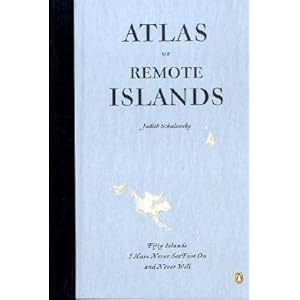
In the preface of Judith Schalansky's Atlas of Remote Islands: Fifty islands I have never set foot on and never will, she describes a similar experience of maps, atlases and globes.

While I confess it was the cover of this beautiful book (Schalansky trained as a graphic designer, and had designed the book and laid out the text) that first drew me, it was a brief read of the preface that convinced me to take it home from the bookstore. In the preface, Schalansky teases out man's fascination with the far frontier, our desire to conquer via knowledge and documentation, and the story threads behind these abandoned, conquered, disputed, cursed, marginal slivers and dots in the vast oceans.
An island offers a stage: everything that happens on it is practically forced to turn into a story, into a chamber piece in the middle of nowhere, into the stuff of literature.(p20)
For each of the 50 islands covered, Schalansky reproduces a drawing of the island on a scale of 1:125000, and offers a write-up crafted from facts and stories culled from histories, travellers' reports and other accounts - fictionalised fact, fact as fiction.

For me, the names of these islands alone are enough to fire the imagination.

Imagine: Possession Island, Deception Island or the first entry in the book Lonely Island. The names of places on these craggy, icy or just plain uninhabitable places tell equally of their painful realities. Try spending the night at Misery Fjellet or the Comfortless Cove! Even those islands with less unfortunate names promise some kind of an adventurer's tale (Raoul Island, Tristan da Cunha, or the fictionalised Robinson Crusoe Island) or folklore as exotic as the sounds of Banaba, Takuu or Tikopia.
Peaceful living is the exception rather than the rule on a small piece of land..."(p19)
I guess islands will always fascinate us, just as cities do. Both provide the circumscribed conditions of laboratories, prisons and retreats. The former bound by physical nature, the latter by human nature.

Schalansky's own story illustrates the boundaries of a city being drawn, redrawn and erased. Born in East Germany, when travel out of the country was not possible, Schalansky's early fascination with maps was somewhat ironic. Yet when the Berlin wall fell and she was free to travel out of t=her country, the country itself "disappeared from the map". It seems apt that she now resides in Berlin, in this renegotiated city.

Of course, it is also hard not to think about our own (in comparison) less remote and larger island when reading this book. Like many of these remote islands, our island can speak also of a colonial past, mythic and fictionalised creatures, (to many still) authoritarian powers and the utopian dream, or islandwide scientific/sociological experiments.

But unlike these islands, geography has undoubtedly given us a kinder fate.

Saturday, January 29, 2011

winged things


leaf after a pagoda box worm is done with it -image by J

It became a winged thing imperceptibly, as a maturing face imperceptibly becomes beautiful. And its wings - still feeble, still moist, kept growing and unfolding, and now they were developed to the limit set for them by God, and there, on the wall, instead of a little lump of life, instead of a dark mouse, was a great Attacus moth like those that fly, birdlike, around lamps in the Indian dusk.

And then those thick black wings, with a glazy eyespot on each and a purplish bloom dusting their hooked foretips, took a full breath under the impulse of tender, ravishing, almost human happiness. [From Nabokov's story in Russian "Rozhdestvo", reproduced in Nabokov's Butterflies]
It was actually Facebook that had sent me to find and wipe off the dust from my copy of Nabokov's Butterflies. And as I was reading random parts of the book again, I found the except above. Ah, who else but Nabokov could have written these sentences that seem to take flight, and just when you try to catch you breath, he tries his luck with just that one more word "ravishing". My literary hero.

OK, enough adulation.

The first Facebook link was to this NY Times article on the recent vindication of Nabokov as a lepidopterist. Nabokov's hypothesis was that the Polyommatus Blue evolved and travelled to the New World over millions of years from Asia. This was supposedly dismissed by most professional lepidopterists in his time who perhaps saw his hypothesis as more fiction than a studied possibility. Gene sequencing technology today has proven - finally - that Nabokov was right! Of course, what is fascinating is that a family of butterflies, these slight fragile creatures, had travelled through such enormous distance. Just how many butterflies over how many millions of years would it take?

The second link that led to a blog was left by J's Facebook contact K in response to J's photograph (see above). J had taken of a large leaf he had found that was punctured almost throughout his entire surface. K's link attributed these circular wounds to the appetite of the (pagoda) bagworm.
Bagworm moths are of the Order Lepidoptera, same as the butterflies and family Psychidae. The distinctive feature of bagworms is that their larvae are remarkable architects, building mobile cases made of environmental materials, in this example, the leaves, to hide themselves in. Thus, within each case hides a tiny caterpillar. For the pagoda bagworm, it scrapes the chlorophyll off the leaf before incising cleanly around the area consumed, creating a circular wound. The excised leaf piece is then added to the bagworm’s protective casing.[From the Urban Forest blog]
Images of the pagoda bagworm and other species of the bagworm are quite amazing, their cases looking at times like architecture and at times, almost fluid like a sweeping cloak. And who can resist a name like the "Pagoda Bagworm"! As if a diminutive traveling salesman had renounced the world and retreated, albeit with his bag of samples, into a quiet tower somewhere in Kyoto.

These little discoveries make perfect a rainy Saturday night.

Monday, January 18, 2010

a drifting line


Click on each image for a larger view

JasN (B in the above sequence) suggested that we record our experience listening to and queuing for the inspiring Yoshihiro Tatsumi in a single panel drawing. Being less disciplined, we needed fifteen panels instead to mark the start and end of our groupie fanboy/girl days. And of course, the amazing 74 year-old artist wins our respect for his tireless dedication to signing/drawing for the line...

Well friends, while we enjoyed our Sunday afternoon pondering the intricacies of whether one should order 10 packets of prawn mee if there was a long queue standing behind, we recommend that your afternoons are better spent reading his short, sharp and shock(ing) stories instead. They have been collected, translated and published by Drawn and Quarterly in three volumes thus far.

The manga master's lengthier autobiographical tome A Drifting Life moves at a less punishing pace, but nonetheless leaves you wanting to read more. If so, there's Singaporean film maker Eric Khoo's animated adaptation of A Drifting LIfe (artist Brian Gothong Tan will also work on the project) to look forward to.

Sunday, November 8, 2009

city of books

book/wall
all images by J

Notwithstanding this, J and I do try to explore at least one district that we've never been to each time we visit Tokyo. This year, it was Jimbocho. It's a name I almost feel should be an exclamation. Like "Jimbocho!" or "J-I-M-B-O-C-H-O!"

Especially if you love books.

The first thing you'll notice is that there's nothing fancy about Jimbocho's bookstores. Its dedication is singular - books. And the folks who trawl Jimbocho's shelves do not need any encouragement from cute merchandise or interiors. They are - as I point out to J - true in their love for books.

IMG_0107
posters on the wall of a bookstore

Next, you'll find that most of the stores have focused collections. Depending on the store's genre, every possible space is packed with books, magazines or manga. To add, the shelves are meticulously categorised and labelled, and if not, the organisation makes itself obvious, as if in the shopkeeper's own language of association. We had first walked up to a small bookstore on the second-floor focused on the Beat Generation, before stumbling upon a street of shops collecting all printed material related to the cinema and popular culture.

According to the entry by Yoshita Haba in Claska's Tokyo by Tokyo, "the stock on the shelves changes depending on the time of the year, so it's best to make regular visits - bookshelves are like living, constantly changing creatures."

After all this, you'd walk around wishing you understood some of the Japanese language so that you could access more of these creatures.

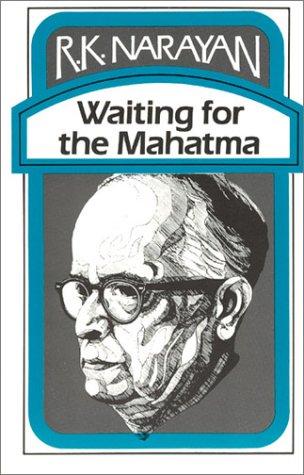
But with no Japanese, the book that accompanied J and I (we took turns reading/re-reading) throughout our stay instead was Narayan's novel Waiting for the Mahatma.

Probably one of the few Narayan stories that dealt with an overtly political context, Waiting for the Mahatma takes Siriam, a characteristically carefree Malguldi resident, and puts him through a coming-of-age experience that is not so much political awakening as an extended schoolboy crush. Guided only by love for Bharati, Siriam finds himself a participant in Gandhi's spiritual reconciliation of India and Chandra Bose's militant independence movement, while the rather benign colonial representatives look on and the Hindu-Muslim conflicts place questions on the nature of India's independence.

Waiting is a somewhat atypical of Narayan's Malgudi novels in the tragic undercurrents of its comedy. As if once outside Malgudi, Narayan's fictional paradise, the realities of India cannot but unsettle Narayan. With its last chapter set in New Delhi, Waiting as a love story cannot find its consummation. The title's anticipation therefore gestures at this always-tentative (political) romance.

It is a strange novel to read during a vacation in consumerist 21st century Tokyo. But returning to this wonderful novel and discovering a new district in Tokyo has been two of my best experiences in the last week.

Tuesday, October 20, 2009

gone to meet the bookmaker

be still
click to view in flickr

The description of Tuas on streetdirectory.com begins "Tuas is Singapore's version of Chernobyl."

Comparing Tuas to Chernobyl is way too flippant, but to most of us islanders who don't work in a shipyard or any of the heavy, manufacturing or chemical industries, Tuas will seem somewhat surreal.

There is really no distinctive architecture - just these monotone blocks, some of them windowless or clad in metal. There are no high rise buildings. Even the trees are low and overwhelmed by the concrete and steel. The streets are wide. Or perhaps they feel especially wide because the traffic is sparse, save for that roaring truck. There aren't many people hanging or walking about as you drive by. But although the place seems deserted, there is the knowledge that inside those concrete and metal blocks, there is almost non-stop activity. Man operating machines operating the economy operating man.

Why were we in Tuas? To visit a bookbinder for one of J's projects.

It was fifteen minutes to one o'clock when we arrived.


A dog stood by the wide entrance. A group of men were resting by the side. The place was dark - and lazy. Of course, it was their lunch break. We were directed to the back of the cavernous space that was filled with pellets of print and quiet machines which resembled abandoned amusement park train rides.

The office was a florescent glow behind a clear curtain of thick plastic. We peeped. On the walls hung portraits of leaders, politicians, gods and celebrities. There was (I think) Osama, Ganesh, Obama, Thaksin, Abdullah Badawi, Mahmoud Ahmadinejad, the Old Man himself, Ella from Taiwanese girl-band S.H.E., the Harvard-educated Japanese princess...

M finally emerged. After a ten-minute discussion between J and M in the office, we turned around and saw, to our amazement, the entire factory floor transformed! The factory floor was lit, the machines grew noisy one-by-one, and a group of some twenty men and women seemed to have appeared from nowhere and were now industriously carting books, folding covers, pushing buttons and supervising machines. M smiled at our undisguised curiosity.


"Come," she offered, "I show you. You never see before, right?"

Our tour, however, was interrupted before it really started by our introduction to Mr S, the boss-man, master bookmaker and lunchtime portrait artist.

"Good good, you must see all the machines, then you designers can understand how it works!"

And so began a personal tour of Mr S's $4 million-worth of secondhand German binding machines ("except this machine, this one is from China. The Chinese they copy everything, exactly the same as the German one."). They fold, glue, stitch, cut, separate, make hardback and cloth covers, apply the little ribboned ends to the spines... all the mechanised hands, wheels, presses and rollers.

"Nowadays, I see the design, aiyah, immediately I can tell: over-designed. They design, don't think about how it can be made. I tell them, this cannot be bound this way. Sometimes simplicity is better." Mr S offered his design advice to J.

About Mr S's portrait painting, he credited it to this - "For one year I studied art and book binding in France, in the 70s. Every day the French, they grill you about binding. So many different things to learn, I tell you. There are so many different ways to bind a book. I also study art, art and book binding."


"One day I saw this exit sign, then I hang these portraits here because they are, haha, *you know*..."


We ended the tour almost an hour later, with Mr S inviting J to organise a study visit for designers to his factory.

"I am preparing some slides about binding. You can go and organise a small group to come lah. But make it informal, we can walk around then discuss. Good that you designers come and see. Make our job easier also!" He laughs.

At two thirty, we walked back out into Tuas' empty streets, thinking about the books that we could possibly make with Mr S's German (and sometimes Chinese) machines.

Sunday, October 4, 2009

island biography


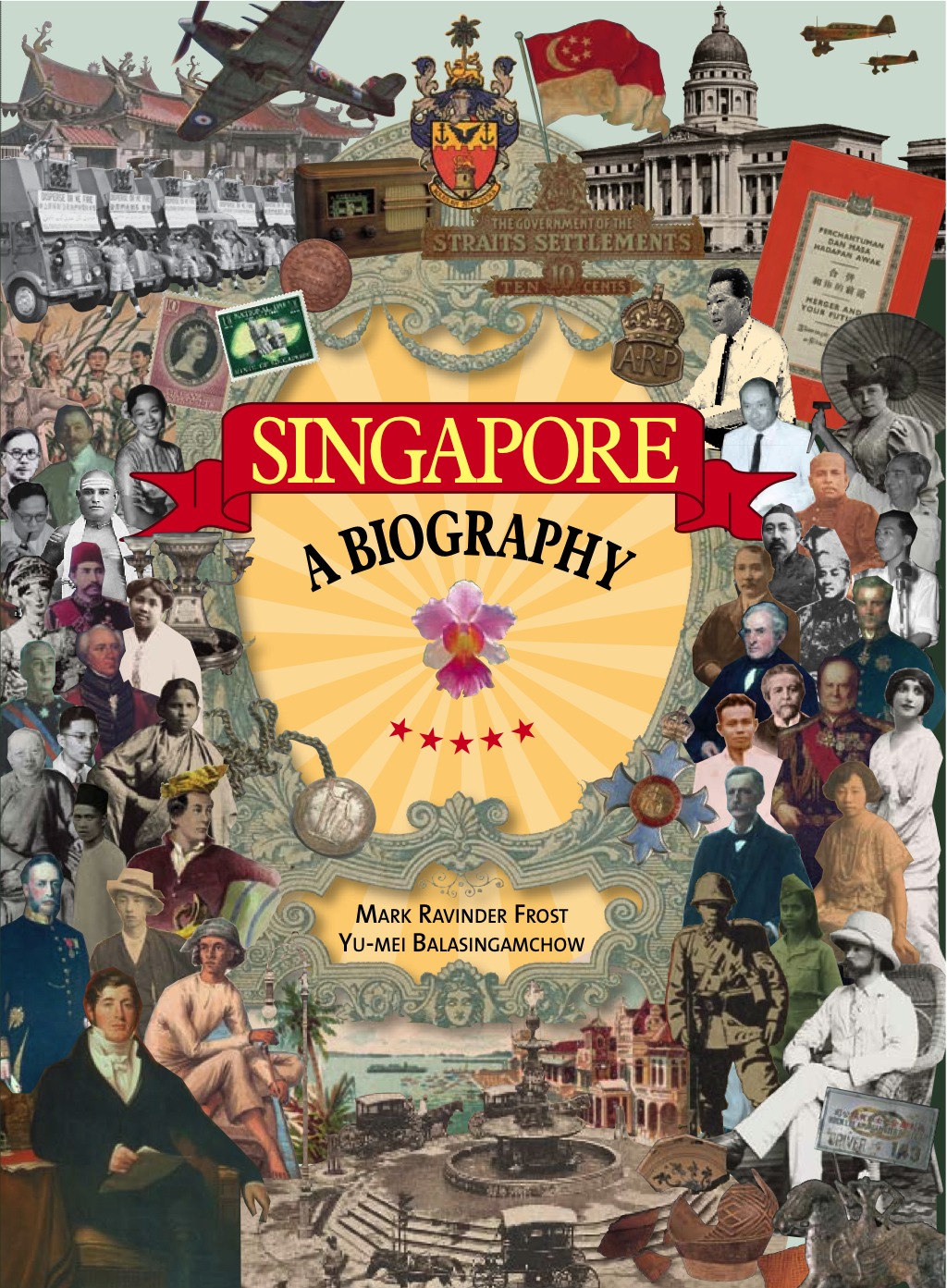
Check out this book by tym and Mark Frost about the lives that made our favourite island in the tropics! From the previews so far, the book promises to be a great read.

There are 4 things amps recommend that you do:
(1) Read the previews/snippets from the book and the writers' posts here.
(2) Buy your copy from the bookstores, or pre-order one. Of course, proceed to read it!
(3) Attend one or all four of these events where the writers will talk and gamely sign your copy of the book.
(4) Buy another copy for a friend.

Monday, September 7, 2009

a distraction that is not facebook

Unknown/darkness (黑/迷)
image by J. Nothing to do with this post. It's just a cool picture of the universe in a glass of iced water.

In between writing my dissertation, I've been reading the following books online. But being the bibliophile that I am, they have since appeared on our shelves, save for the rarer Annals. If you need reasons to get Facebook off your computer screen, here are three good ones:

Troy Chin's Loti is uploaded by its author regularly on his website. It could be that the stories are nostalgic for most readers. Not the sepia-toned variety, but the household kind - familiar experiences of childhood - primary school tests, a classmate's birthday party, corny jokes, haunted houses in the neighbourhood, visits to the "wet" market. It could be the innocence and naivete of the characters. Of course, it could be Troy Chin's comic timing. Whatever it is, this is one addictive comic.

[Volume 1 of Loti is available in print in most bookstores, as is his Resident Tourist.]

A 1821 copy of John Leyden's translation of Malay Annals or Sejarah Melayu is available on NLB's digital archive. It has an introduction by the white man Raffles himself, a fascinating read for his critique of Dutch imperialism as justification of the British administration, as well as his characterisation of Southeast Asia's diversity in the "absence of bigotry and inveterate prejudice" (Raffles notes that this trait also makes the region perfect for EIC's moulding, "the humanizing influence of the arts" and the creation of new wants and luxuries!).

Anyway, the civil servant introduction aside, the rest of the Malay Annals - a series of stories surrounding the Malaccan sultanate and various noblemen's exploits, including outwitting foreign emissaries and forces. A commissioned work, it is also an example of how the arts have, to varying extent, have served their patrons' vanities and purpose - just as how Leyden's translation, endorsed by Raffles, furthered the British empire's "brand" of imperialism as enlightenment. But don't let this put you off. If not as an historical account of 15th and 16th century, read Malay Annals like any romantic narrative, especially one that begins like this:
It happened at a time that Raja Secander, the son of Raja Darab of Rum, of the race of Makaduniah, the name of whose empire was Zulkaneini, wished to see the rising of the sun...


I suspect, however, that the manga Pluto may have a less legitimate online presence. So you should either borrow the books from us, buy them, or else ask google - because this series by Naoki Urasawa shares the genius of Osamu Tezuka and is well worth reading.

Tezuka, creator of Atom or Astro Boy, has always written works that hit at man's insatiable greed and corruption as the root of war and bigotry. They would have been depressing, moralistic rants if not for how Tezuka inserts such tension into man's redemptive efforts as well.

Astro boy, or robots, as an idealised image of man is something Hollywood has appropriated, mostly poorly. But in Pluto, an adaptation and continuation of Tezuka's original Astro Boy manga, the conflicts between the ideal and corrupted often remain unresolved, as with the line between man and technology. For example, when a robot cop is "killed", the robot-detective informs the cop's robot wife and offers to place the cop's memory chip in her processor. This leads to a strange but moving depiction of mourning and loss as a literal "playback" of memories. In a way, it's not unlike the kind of flickr/facebook/blogger archiving we do today - except that it's private and unedited.
So friends, on this note, I'll leave you to your facebook-ing reading.

Sunday, August 23, 2009

birdsongs


Over the weekend, J and I went with tym to check out the "Curating Lab: 100 objects" project under the Singapore Art Show. The first object was of a series of blown-up 1960s newspaper clippings from artist John Low's collection. Other than sightings of the "Oily Man", "beast in Serangoon Gardens" and ghosts in cabdrivers' backseats, there was a kind of non-article (if there was ever such a thing as non-news, this would be it) about some kampong residents' alarmed sighting of a "death bird" and its call. From its description, the "death bird" sounded just like the common house crow. Perhaps they were less common in the 60s. If so, maybe it is not too difficult to imagine then how a lone crow could possibly alarm a kampong with its aggressive cawing and its seemingly ominous haunting.

Round about eight in the morning, a bird in the cluster of trees by our block of flats will issue a series of loud echoey calls - "whoooop whooop". A couple of mornings ago, I woke up hearing just that loud call; and drifting in and out of sleep, all that filled those brief in-between moments was the bird's call. A kind of audio-only dream.

How would you describe the calls and songs that birds make? Pigeons coo. Crows caw. Mynahs, those comical birds with their random head shaking and awkward hopping, they make these appropriately untuneful clicks. And hummingbirds hum?

It is hard to forget Murakami's description of the "wind-up bird":
There was a small stand of trees nearby, and from it you could hear the mechanical cry of a bird that sounded as if it were winding a spring. We called it the wind-up bird. Kumiko gave it the name. We didn't know what it was really called or what it looked like, but that didn't bother the wind-up bird. Every day, it would come to the stand of trees in our neighbourhood and wind the spring of our quiet little world."

Then there are the more prosaic but no less curious descriptions in Clive Briffett's A Guide to Common Birds to Singapore (part of this series of pocket-sized books published by the Singapore Science Centre that I am addicted to), such as:
...it issues a monotonous two note whistle "coo-oo" fairly regularly every two seconds and has been likened to a demented hiccupping! (Brown Hawk Owl)
Often calls attention to itself using a raucous call followed by a noise resembling a whinnying horse as it sits on overhead wires (White-throated Kingfisher)
Frequently issues a noisy shriek resembling a saw grinding against metal (Collared Kingfisher)
...listen for the distinctive call of "whats it" or "peepit" issued in flight (Asian Fairy Bluebird)
...has a "chwee chewee" call with an alarm note resembling a "tissyip tissyip" (Richards Pipit)

I've been listening to online recordings of bird sounds for the past hour, hoping to find the name of my morning alarm clock. But until I recognise it, I think it'll just bear the unflattering name: the wake-up bird.

========
p/s If you want to listen to an actual bird songs in Singapore, there's actually a CD recording Bird Songs of Singapore at the National Library (Lee Kong Chian Reference section.

Wednesday, May 20, 2009

poetry day

cicadasong
Very loose translation: "How can you wait until the autumn day clears, when the sun is setting and the cicadas call!" - late Tang poet Li Shangyin. Drawing of Pa J as J distracted him with small talk.

Three anthologies of classical Chinese poetry sit on my shelves. One has pictures and pinyin (hoorah!) accompanying every poem. I bought it years ago wandering discount book fairs. Another is a 500-page tome with a grandiose title Song of the Immortals. I have forgotten how it found its way to my bookshelf. The third is an anthology of Chinese lyrics, translated by a Chinese scholar Chu Dagao, who had studied at Cambridge in the 30s. It cost me BP3.30 from a second-hand bookstore in that British university town. As if reflecting the weight of their content, they are all hardbacks - even the picture book - and are built to last.

The books left their shelf and jacket of dust some weeks ago. I was searching for a Chinese poem that would go with a drawing of Pa J that J and I made one Friday evening. We had abandoned the TV the rest of J's family was watching in the living room and sat with Pa J listening to FM95.8's dialect news broadcasts on his portable radio at the dining table. It was a hot evening. Finishing the drawing at our home, I thought of the cicada and the sound they make.

The exercise got me reading (however poorly) some of the poems again, alternating between the dense Chinese text and its almost always-awkward English translation. One of the first poets in that anthology Song of the Immortals is the Zhou Dynasty poet Qu Yuan 屈原.

If he sounds familiar, it's because we all have him to thank for this!.

Friends, just to jolt your memory (probably from your Primary School Chinese textbook) - Qu Yuan was a politician/minister to the King Chu. His advice to the King not to walk into the ambush set by the Qin King and to form an alliance with the other states instead was ignored. This and the jealousy of other officials led to his being sent into exile where his poetic sensibilities were stirred. Some of the earliest recorded Chinese poems that were attributed to a specific/named author were by Qu Yuan. When the Chu state finally fell to the Qin empire, in despair Qu Yuan jumped into the Mi Luo river. The commonfolk who loved Qu Yuan, the patriotic and righteous public servant, supposedly threw rice packets into the river in a bid to distract the fishes from eating Qu Yuan's body. If that was not enough, they beat drums and rowed boats on the river for similar effect.

But Dragon Boat Festival is an uninspiring name for what is otherwise a great story. Us amps will, from now on, eat rice dumplings on Poetry Day, the 5th day of the 5th lunar month.

==============
p/s. Poetry Day falls on 28th of May this year.

Wednesday, April 22, 2009

remembering

memory
lyrics from the folksong 青春舞曲 should read 我的青春小鳥一樣不回來.

It was 2002. I was in Hong Kong for a work-related visit. I don't remember where exactly in Hong Kong it was or what led me there, but there I was, in the audience of a kind-of remembrance event on the passing of Singapore theatre practitioner Kuo Pao Kun. A mic was set up in front of the small auditorium. The carpet and curtains were a deep dark blue. There may have been a lit candle (but memory plays dramatic tricks). A group of Hong Kongers were in the audience. There were some speeches in Cantonese.

Recent discussions about LKY's legacy, civil society (ah, the AWARE saga) and an arts NMP brought back memories of this experience in Hong Kong, as well as those very brief, by-the-way encounters with Mr Kuo. I wonder if younger folks on this island will remember and study his works? Because it was reading Kuo Pao Kun's Papers and Speeches, Volume 7 from his Complete Works (ed. Quah Syren, World Scientific Publishing) that made it clear why he is often missed - not just as a dramatist, but as a kind of cultural voice, the closest we get to a public intellectual.

Perhaps his plays, essays and speeches come across as powerful because they carry with them an equivalent weight in action and in a life well lived. He thought, he wrote, he felt, but he also interacted, taught/mentored, acted on his vision, and influenced and inspired private individuals and public officials to contribute. In addition to his plays, he founded the Practice Performing Arts School, the Theatre Practice, the Substation (this island's first independent art centre), and the Theatre Training and Research Programme.

It is 2am and I realise now I was being too ambitious in wanting to highlight some of the observations about the arts, culture and civil society he has made! Far wiser to simply recommend the 10-volume complete works, including the 7th volume containing his essays and speeches. There is also Kuo Pao Kun: And Love the Wind and Rain (image left), a 2002 volume with a few of his essays, some recordings, and the reflections of his peers and other artists. The books are guaranteed to start you thinking... and hopefully, acting! After all, Kuo Pao Kun's most quoted phrase (the title of an essay/article he wrote?) is "Better a worthy failure than a mediocre success".

Monday, March 16, 2009

island ecology

Over the weekend at the Natural Sciences shelves of Kinokuniya, I chanced upon over thirty titles of pocket-sized guides published by the Singapore Science Centre from the late 80s- 90s on various aspects of plant and animal life on this island.

Unable to resist, I bought A Guide to the Threatened Animals of Singapore (1st published 1995, reprinted 1998) edited by Peter Ng and A Guide to the Wayside Trees of Singapore (1st published 1989, various reprints since) written by Wee Yeow Chin. They've both been hard to put down.

Imagine these storied names...the Missing Marvelous Katydid, the Silver Forget-Me-Not, the Saint Andrew's Cross Toadlet. Or consider the sad gaze of this stuffed Banded Leaf Monkey at the NUS Raffles Biodiversity Museum, supposedly one of two subspecies of mammals found only here (image from WildSingapore.

Novelty aside, that most of the pages were on threatened reef and mangrove creatures made real for me this city's identity as an island - a reality we exploit through reclamation, and in this way, an identity that we inadvertently erase and rewrite.

That we are in the tropics (damn the humidity and heat!) gives rise to this great sentence in the guide on wayside trees- "Nearly all trees planted in Singapore develop flowers eventually" (italics mine). In the same way, the "garden city" vision would almost appear like destiny if it was not a determined, well-planned outdoing of Raffles and his friend Farquhar, those colonial enlightenment botanists.

=====
For a complete title list, see this. They are also available at Kinokuniya, Select Books Popular Bookstore and public libraries.

Tuesday, January 20, 2009

in sequence

oldbridge (橋)
J sun bathing

The sun is back on our island.

I almost forgot about the sun. But still, there is something reassuring in its return. Not for its monotonous heat, but for the semblance of a pattern or season that it brings. Another season, of which this island has three: hot & humid; rainy & sleepy; indoor and aircon.

J is watching online the live CNN coverage of Barack Obama's inauguration as US President, the rehearsed process of ceremony. I guess everything happens in a sequence of patterns, order, influence - whether or not we recognise it at its occurrence. And maybe this makes historians a kind of sequential artists.


Artwork by Jose Munoz

When I first heard the term "sequential art", it seemed an odd way of describing what was explained to me as comics. My first "graphic novel", a second-hand 1987 English copy of Joe's Bar by J. Munoz and C. Sanpayo, but I didn't recognise it as "sequential art".

Though composed of distinct frames, in reading, the eye and mind does not stumble across the borders. The narrative in fact proceeds seamlessly - the relationships between idea, characters and events told not only in text, speech, but image and imagined motion. In this way, the graphic novel form lends itself well to the telling of history, personal or public.

Jason Lutes' Berlin (a series that has been compiled so far into Book I "City of Stones" and Book 2 "City of Smoke") is an engrossing network of stories set in the German capital between the world wars. You begin with a community of artists and students, unsure of where their stories will take you. Somewhere in between, you may even get a little lost as the stories multiply to include the city's journalists, workers, vagrants, hedonists, musicians, police, politicians... all this while building a picture of the political and artistic ideas and ideals that were born from the formation of a new German republic and led to its later fascist, Nazi regime.

Like any good piece of historical fiction, Berlin immerses you in the details of the fictional world and lives created, but allows you to eventually identify the larger historical narrative, an inevitable historical sequence.

Ah, Obama's speech has ended. To my right, J's screen shows Bush's helicopter exit from Washington. And despite the daytime heat, the night is surprisingly cool and breezy still - perfect for sleep.

========
p/s - Also check out Art Speigelman's famous Maus, completed in 1991, a story about Holocaust survivors; Chester Brown's biography of Canadian rebel Louis Riel; or Singapore's own To Tame a Tiger by Joe Yeoh.

Friday, September 19, 2008

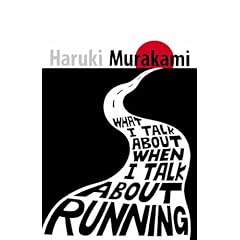
what we talk about when we talk about running


the original running man

On our island, running has become the latest fad. This year alone, there has or will be the Nike "Human Race", the Great Eastern Women's race, Adidas' sundown marathon, the super crazy "double marathon", some new balance thing, the annual standard chartered run...and too many for a non-participant to name. It's a little bit more crazy than when yoga and roller blading were the rage, perhaps because running is something you can do alone and is basically a outcome/goal-driven activity, quantifiably by time, speed and distance.

Maybe this is why this book flew completely off the shelves, but Kinokuniya has re-stocked it again.

Now that I got my copy of Murakami's latest "memoir" comprising reflections on running, I wished I had just borrowed a copy from the library. The prose is thin and loose. The premise is indulgent. Or rather, the premise is indulgent because the prose is thin and loose. And perhaps owing to the conversational tone (after all, the title does declare that its talking), Murakami's attempts to link running to writing are not so much contrived as they are pedestrian. And for an activity - running -that requires much discipline, Murakami did not appear to show any in the writing. This is a book that ought to be just a 800 word essay.

If you are a Murakami-fan and finding it hard to believe that he can write something pedestrian? Well, it could be because of the subject matter. To demonstrate, us amps attempted a version of "talking about running", since J is also the running type:

Y: J, you are a runner. You have been running voluntarily since you were young. You enjoy running. You feel ill if you don't run for some time. Tell me, what do you think about when you think about running?
J: Well, mostly, when I run, I think about...
Y: No, not when you are running. What do you think about when you think about running?
J: Erm, slimming down.
Y: So superficial!
J: Well, if you want a more PC term, try "keeping fit".
Y:Keeping fit is too utilitarian. What else do you think about when you run?
J: OK, when I run, sometimes I also think about and get new ideas.
Y [*yawn*] It's late. I think I am going to bed.

Sunday, August 24, 2008

the world at home

only one
my fellow commuter who is past heeding the Prime Minister's call to procreate - click for larger flickr view

On a bus, a younger colleague who had just gotten back from studies in America last year glanced outside at the new entrance to the Orchard MRT station and remarked, "sometimes I feel like a tourist in Singapore. Like when I come to this part of town, there's always something new and I think - wow, I've never seen this before...".

She said this casually, without any angst about "a sense of belonging" or any pointed reference to the pace of change on this island. Her sentiment is not unique, though the shades are as many as the folks who express it.

A few are captured in Troy Chin The Resident Tourist, a 3-part (so far) graphic novel about his move back to Singapore after 9 years in NY and Philadelphia.

The Resident Tourist is no different from other graphic novels with an autobiographical slant in having these elements: a somewhat depressive and nerdy narrator, a self-absorption that alternates between charming and annoying, references to childhood traumas and dreams, the close-yet-so-faraway girl/guy friend etc. Of course, what makes The Resident Tourist particularly enjoyable is the familiar Singaporean context. The indulgent Teochew grandmother, the reunion of Secondary School buddies, geo-caching (which I recall some friends being strangely fond of), the fact that most of the characters are bespectacled, the re- and dis-locations of Singaporeans who had spent some time away from the small island, the quirks and desires of Singaporeans who want to have it all on this small island, or the experience of finding a baby bat in your shoe are things many can relate to (OK, maybe not a baby bat, but perhaps a house lizard?).


Troy Chin's drawing is somewhat raw and uneven in Part 1, but by Part 3, the frames are a lot more layered and the perspectives more varied. All in all, with the weather turning rainy this time of the year, us amps recommend The Resident Tourist for a stay-home read on lazy, cool sheets. Plus Troy Chin knows how to tease the reader with some curious bits in the narrative.

Besides, if like J and I, you also have a soft spot for video arcades, you'll want to like the narrator.

And as a kind of afterword on the desire to see/have the world, playing in the background as I'm typing is Bjork's wonderful "I've Seen It All"... What about China? Have you seen the Great Wall? All walls are great, if the roof doesn't fall... The Eiffel Tower, the Empire State?/My pulse was as high on my very first date!


======
p/s Parts 1 and 2 of The Resident Tourist are available as palm-sized paperbacks from Ani-Play at Sunshine Plaza for $10 each, and Part 3 can be read online.

Saturday, June 28, 2008

makers, keepers

On my morning commute the past week I've been reading the Tangent's latest issue of its journal on "The Makers and Keepers of History".

The short essays by historians and researchers describing their experiences of trying to access documents, archives and memories are humbling. Some are fairly straightforward accounts of the difficulties of getting government agencies to allow access to their files and archives. Most of these experiences have been negative. The descriptions are matter-a-fact, but the reader can sense the frustration or is invited to wonder at the suspicion and the impenetrability of a "no". Others are more personal accounts of interviews, chance encounters and the politics of documenting. These are stories of relationships forged, grown.

Who are the "makers" of history? The larger-than-life politician or the many individuals who collectively lend power or privately shape lives; the government archivist or the historian? And are the makers of history themselves "keepers", a repository or a self-appointed/state-authorised gatekeeper? Where is history indeed situated?

These questions distracted me from the marching feet, anxious glances at the time and bodies trying to stake their space in the cabins of the morning train. Besides, there have other makers and keepers I encountered the past week -

Another kind of makers

J and I have always lamented the lack of appreciation on this island for craft, for the ability to make things, for work and jobs that cannot be done behind a desk or in a boardroom.

In this month's issue of I.D., sociologist Richard Sennett makes a more eloquent advocacy for connecting the head and hand.


A stranger kind of keepers

In Pa J's house are several canaries, "putehs", a pair of parakeets, a grey parrot, and a fish tank that used to be home to 9 red fishes with fat lips. The birds are still caged up, but after Ma J passed away, the fishes were given away. Instead, the fish tank now houses a 10-inch arowana. One of J's many brothers, the keeper of the birds, had bought the fish to improve Pa J's luck at 4D.

Bro J: How, what do you think of the fish? Can you spot the difference after so many weeks?
Y: er ... yah, it seems to have grown.
Bro J: What else?
Y: Er... it's scales are getting less red now. This kind of fish not supposed to be red, right?
Brok J: [looking slightly worried] Is it? No lah, actually this kind of fish can be red also. You can't see the difference ah?
Y: ... [attempts to look more closely at the trapped creature]
Bro J: Eh, eh, I tell you? [lowers his voice to a whisper] But I tell you, here. Come, don't stand there...
Y: Huh, why?
Bro J: [continues to whisper] the fish is very sensitive one, it is very pan tang (trans: superstitious), so better don't let it hear what we are saying...

J's side of the family never ceases to amaze.

You talking to me?

Friday, May 23, 2008

bibliophilia

read (讀)
it really is - design by J amps

It's that time of the year for Read Singapore again - but hey, why wait for some government agency to tell you to read (in caps and with an exclamation, no less) before you do so? This year, amps bring you another poster on why reading is what it is.

But I wonder if there can be folks who love books but don't read, bibliographers who judge the book by its cover, weight, smell, texture, size, font, layout...and love everything but its content. Ah, surely it would be a fleeting, superficial love. Or lust.

So it was with some skepticism that I read this article in the Design observer about attempts to arrange books by colour.

"For one, books he's purchased or received as gifts are books he knows and often loves, and the color of these books is a major part of the experience of interacting with them [...] Another of Luke's reasons is this: organizing his books by color allows him to discover new and unexpected relationships between books he knows well already. When two unrelated books are forced to occupy the same shelf simply because of their spine color, the shelver is asked to think about whether they have ideas to share between them." (extract from the article by Rob Giampietro)

I guess as an experiment to place style over meaning (and whether new meaning emerges) may yield random interesting results, but poor Dewey will have such a fit!

Yet there is also no one way of arranging your bookshelf - how you do so reflects your experiences, biases, priorities.

For me, poetry deserves its own shelves. As do graphic novels and their gradual melding into a long series of art, illustration, design and photography books (the greyness of these borders mirror too the disciplines' own inter-mingling) before transiting via Maurice Sendak to 2 other shelves of children's books. American writing stands distinct from everything else in chronological fashion - reflecting, aiyah, America's cultural imperialism and my own bias! The English too, stand apart - an island onto themselves. Chinese writing (I've unfortunately not made a distinction with Taiwanese text, against my belief that Taiwan should remain its own green island) spills into the rest of Asia, as is the case today with everything else made-in-China, leaving only Japan and those translated Japanese texts providing a balance of power. The Italians, talented as they are, share the space with the Latin Americans and Central Europeans. And exiled to the pitiable depths of the floor-height shelves are books I don't wish to have any claim over - management texts and advertising books.

And there's still the reading to do.

============
p/s Feel free to download the posters from 2006 and 2005.

Monday, May 5, 2008

when I was a child

when I was a child
...I thought like a child - new painting after months!

At the beginning of the film Taxidermia by Hungarian Gyorgi Palfi, a narrator drawls on that "it is only towards the end that the beginning becomes important" (or something like this).

In a film that is really 3 short short films on 3 generations of men and their accidental fathering of the next, you are invited to witness a grotesque parade of physical (and sexual) deprivation, followed by excess made into sport and ultimately greed, then the slow paring away as skin sheds flesh and all other semblance of life. Of course, running parallel to the men's stories are post-war Hungary (a land-locked state trapped still in its feudal society), Communist Hungary and, I guess, today's republic. Their lives reflective of, yet strangely displaced in these 3 transformations of their society.

This is a rather dull summary of a visually rich and entertaining film! I assure you the cinema laughing, cringing, squirming and fairly nauseated. [I think it is still screening, though probably at odd times, at the PictureHouse.]

The film aside, it was the narrator's initial statement that stuck because it reminded me of critic Edward Said's memoir Out of Place I was reading.

Said died in 2003, having struggled with leukemia for several years. In the preface, he wrote of how his illness and the closeness of death set him the writing of a memoir - revisiting his childhood in Cairo and Palestine, and all the associated ambiguities in the inexplicable genesis of his seemingly English name, his Christian family, his long period away from Palestine, his adopted American home and the contradictions or ironies these seem to pose with his criticism and works on Orientalism, the Palestinian state, American imperialism etc. It is towards the end that the beginning becomes important.

It is a quietly reflective and sometimes difficult book. It is difficult in its honesty about Said's feelings towards his parents, family, homes. Reading Said's memoir somehow also brings out just how difficult growing up can be! For all the romanticism surrounding childhood, being a child is perhaps not easy. The uncertainties and insecurities. The need to de-code the adults' insinuations and whispers with what little you are given to know.

One of the words I learnt from reading Edward Said years ago while I was in university that I will always remember is palimpsest

palimpsest \PAL-imp-sest\, noun:
1. A manuscript, usually of papyrus or parchment, on which more than one text has been written with the earlier writing incompletely erased and still visible.
2. An object or place whose older layers or aspects are apparent beneath its surface.

Tuesday, April 22, 2008

flowers' city

bubbles (泡)
bubble city - image by J

There is nothing correct - politically speaking - about Saint Jack, the 1979 film by Peter Bogdanovich based on Paul Theroux's novel of the same name.

A Chinese shopkeeper repeatedly refers to the American pimp Jack Flowers (Peter Gazzara) as ang moh, and eventually gets chided by the deadpan Jack "hey, you don't want me to call you chink" (or something like that). The British colonial castoffs in Singapore get drunk, prance around in their undies, mumble some cynicism and sleep with the prostitutes Flowers pimps. The Americans are horny Michael Fays off to Vietnam or men in cowboy hats and big cars. And of course, our favourite Asian men are either loutish gangsters with no style even when they swear, a dwarf, grouchy suspicious old men in a shophouse (or behind the bar counter), or a pimply teenage male prostitute along Tanglin Road. The first Indian woman the camera has any interest in is a Ceylonese "black" beauty who later unravels her sari and becomes Flowers' bedmate. And there are plenty of Chinese tarts with hearts - for Jack the saint, of course - even his Ah Mah loves Jack enough to nag him to eat everytime she appears - "if don't eat you will die."

But despite or maybe because of all this, the film is not dishonest about its essentially white/caucasian, male view of this island in the 70s. And while the writer/director may intend for the island to be the other character in the film (in a pointed scene, Jack Flowers tells a British visitor the Sang Nila Utama story - and how he named the island Lion City after seeing Tigers - yeah), the truth is that this island, its people and its context, is but a backdrop for what is essentially a story about an American middle-aged drifter in the tropics who is both trapped and redeemed by his romance of being an American middle-aged drifter in the tropics.

The title "Saint" and his surname Flowers is therefore both innocence and crude irony - all the "de-flowered" women and boys. When the island gangsters capture and tatoo cheap insults all over both his arms, he goes and tatoos flowers over them. Hearing one of his prostitutes lament about her boyfriend, he promptly removes his watch and gives it to her for her to appease her man. But he is, after all, her pimp. Paid handsomely to take photographs of an American senator in a tryst with a male prostitute, he in his final "redemptive" act, decides to destroy the photographs (and in doing, destroys his lucrative business contract providing "R&R" to visiting GIs) - but we also see him walking back into the squalid streets of this island to pimp some more.

bright lights, big city (放蕩)
image by J

Even if you live on this island and watch only action/thrillers/horror flicks, Saint Jack will be enjoyable simply for the scenes of the old Seletar airport, Bugis when hawkers would walk by and place dildos for sale on the table (or so the film portrays) and prostitutes (transverstite?) would sport big white afro wigs a la a Wong Kar Wai character, the relatively unchanged Raffles Hotel, a Shangri La hotel that is seemingly set in the wild... bum boats carrying goods in the Singapore River and a grotty Clarke Quay before it was disneyfied for tourists and yuppies. Heck, so what if all this only perpetuates the idea of the seedily "exotic" East and our own sad, distorted nostalgia!

It's a surprisingly watchable film and Ben Gazzara's portrayal of Jack Flowers so effective attracts and repels.

========
p/s Saint Jack is available on DVD at HMV or your regular video store.