Showing posts with label reading. Show all posts

Saturday, February 26, 2011

on another island


image by J

Paradise is an island. So is hell. (p6)
I remember having a world map pinned on the wall of my bedroom when I was growing up. But that was before my father brought home a beach ball-sized model globe. It was a relief model, where if you ran your finger across the surface, you could "read" the mountain ridges.

In the preface of Judith Schalansky's Atlas of Remote Islands: Fifty islands I have never set foot on and never will, she describes a similar experience of maps, atlases and globes.
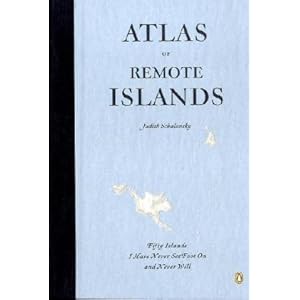
While I confess it was the cover of this beautiful book (Schalansky trained as a graphic designer, and had designed the book and laid out the text) that first drew me, it was a brief read of the preface that convinced me to take it home from the bookstore. In the preface, Schalansky teases out man's fascination with the far frontier, our desire to conquer via knowledge and documentation, and the story threads behind these abandoned, conquered, disputed, cursed, marginal slivers and dots in the vast oceans.
An island offers a stage: everything that happens on it is practically forced to turn into a story, into a chamber piece in the middle of nowhere, into the stuff of literature.(p20)
For each of the 50 islands covered, Schalansky reproduces a drawing of the island on a scale of 1:125000, and offers a write-up crafted from facts and stories culled from histories, travellers' reports and other accounts - fictionalised fact, fact as fiction.

For me, the names of these islands alone are enough to fire the imagination.

Imagine: Possession Island, Deception Island or the first entry in the book Lonely Island. The names of places on these craggy, icy or just plain uninhabitable places tell equally of their painful realities. Try spending the night at Misery Fjellet or the Comfortless Cove! Even those islands with less unfortunate names promise some kind of an adventurer's tale (Raoul Island, Tristan da Cunha, or the fictionalised Robinson Crusoe Island) or folklore as exotic as the sounds of Banaba, Takuu or Tikopia.
Peaceful living is the exception rather than the rule on a small piece of land..."(p19)
I guess islands will always fascinate us, just as cities do. Both provide the circumscribed conditions of laboratories, prisons and retreats. The former bound by physical nature, the latter by human nature.

Schalansky's own story illustrates the boundaries of a city being drawn, redrawn and erased. Born in East Germany, when travel out of the country was not possible, Schalansky's early fascination with maps was somewhat ironic. Yet when the Berlin wall fell and she was free to travel out of t=her country, the country itself "disappeared from the map". It seems apt that she now resides in Berlin, in this renegotiated city.

Of course, it is also hard not to think about our own (in comparison) less remote and larger island when reading this book. Like many of these remote islands, our island can speak also of a colonial past, mythic and fictionalised creatures, (to many still) authoritarian powers and the utopian dream, or islandwide scientific/sociological experiments.

But unlike these islands, geography has undoubtedly given us a kinder fate.

Sunday, November 8, 2009

city of books

book/wall
all images by J

Notwithstanding this, J and I do try to explore at least one district that we've never been to each time we visit Tokyo. This year, it was Jimbocho. It's a name I almost feel should be an exclamation. Like "Jimbocho!" or "J-I-M-B-O-C-H-O!"

Especially if you love books.

The first thing you'll notice is that there's nothing fancy about Jimbocho's bookstores. Its dedication is singular - books. And the folks who trawl Jimbocho's shelves do not need any encouragement from cute merchandise or interiors. They are - as I point out to J - true in their love for books.

IMG_0107
posters on the wall of a bookstore

Next, you'll find that most of the stores have focused collections. Depending on the store's genre, every possible space is packed with books, magazines or manga. To add, the shelves are meticulously categorised and labelled, and if not, the organisation makes itself obvious, as if in the shopkeeper's own language of association. We had first walked up to a small bookstore on the second-floor focused on the Beat Generation, before stumbling upon a street of shops collecting all printed material related to the cinema and popular culture.

According to the entry by Yoshita Haba in Claska's Tokyo by Tokyo, "the stock on the shelves changes depending on the time of the year, so it's best to make regular visits - bookshelves are like living, constantly changing creatures."

After all this, you'd walk around wishing you understood some of the Japanese language so that you could access more of these creatures.

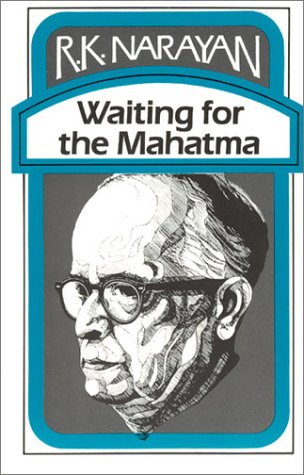
But with no Japanese, the book that accompanied J and I (we took turns reading/re-reading) throughout our stay instead was Narayan's novel Waiting for the Mahatma.

Probably one of the few Narayan stories that dealt with an overtly political context, Waiting for the Mahatma takes Siriam, a characteristically carefree Malguldi resident, and puts him through a coming-of-age experience that is not so much political awakening as an extended schoolboy crush. Guided only by love for Bharati, Siriam finds himself a participant in Gandhi's spiritual reconciliation of India and Chandra Bose's militant independence movement, while the rather benign colonial representatives look on and the Hindu-Muslim conflicts place questions on the nature of India's independence.

Waiting is a somewhat atypical of Narayan's Malgudi novels in the tragic undercurrents of its comedy. As if once outside Malgudi, Narayan's fictional paradise, the realities of India cannot but unsettle Narayan. With its last chapter set in New Delhi, Waiting as a love story cannot find its consummation. The title's anticipation therefore gestures at this always-tentative (political) romance.

It is a strange novel to read during a vacation in consumerist 21st century Tokyo. But returning to this wonderful novel and discovering a new district in Tokyo has been two of my best experiences in the last week.

Monday, September 7, 2009

a distraction that is not facebook

Unknown/darkness (黑/迷)
image by J. Nothing to do with this post. It's just a cool picture of the universe in a glass of iced water.

In between writing my dissertation, I've been reading the following books online. But being the bibliophile that I am, they have since appeared on our shelves, save for the rarer Annals. If you need reasons to get Facebook off your computer screen, here are three good ones:

Troy Chin's Loti is uploaded by its author regularly on his website. It could be that the stories are nostalgic for most readers. Not the sepia-toned variety, but the household kind - familiar experiences of childhood - primary school tests, a classmate's birthday party, corny jokes, haunted houses in the neighbourhood, visits to the "wet" market. It could be the innocence and naivete of the characters. Of course, it could be Troy Chin's comic timing. Whatever it is, this is one addictive comic.

[Volume 1 of Loti is available in print in most bookstores, as is his Resident Tourist.]

A 1821 copy of John Leyden's translation of Malay Annals or Sejarah Melayu is available on NLB's digital archive. It has an introduction by the white man Raffles himself, a fascinating read for his critique of Dutch imperialism as justification of the British administration, as well as his characterisation of Southeast Asia's diversity in the "absence of bigotry and inveterate prejudice" (Raffles notes that this trait also makes the region perfect for EIC's moulding, "the humanizing influence of the arts" and the creation of new wants and luxuries!).

Anyway, the civil servant introduction aside, the rest of the Malay Annals - a series of stories surrounding the Malaccan sultanate and various noblemen's exploits, including outwitting foreign emissaries and forces. A commissioned work, it is also an example of how the arts have, to varying extent, have served their patrons' vanities and purpose - just as how Leyden's translation, endorsed by Raffles, furthered the British empire's "brand" of imperialism as enlightenment. But don't let this put you off. If not as an historical account of 15th and 16th century, read Malay Annals like any romantic narrative, especially one that begins like this:
It happened at a time that Raja Secander, the son of Raja Darab of Rum, of the race of Makaduniah, the name of whose empire was Zulkaneini, wished to see the rising of the sun...


I suspect, however, that the manga Pluto may have a less legitimate online presence. So you should either borrow the books from us, buy them, or else ask google - because this series by Naoki Urasawa shares the genius of Osamu Tezuka and is well worth reading.

Tezuka, creator of Atom or Astro Boy, has always written works that hit at man's insatiable greed and corruption as the root of war and bigotry. They would have been depressing, moralistic rants if not for how Tezuka inserts such tension into man's redemptive efforts as well.

Astro boy, or robots, as an idealised image of man is something Hollywood has appropriated, mostly poorly. But in Pluto, an adaptation and continuation of Tezuka's original Astro Boy manga, the conflicts between the ideal and corrupted often remain unresolved, as with the line between man and technology. For example, when a robot cop is "killed", the robot-detective informs the cop's robot wife and offers to place the cop's memory chip in her processor. This leads to a strange but moving depiction of mourning and loss as a literal "playback" of memories. In a way, it's not unlike the kind of flickr/facebook/blogger archiving we do today - except that it's private and unedited.

So friends, on this note, I'll leave you to your facebook-ing reading.

Monday, March 16, 2009

island ecology

Over the weekend at the Natural Sciences shelves of Kinokuniya, I chanced upon over thirty titles of pocket-sized guides published by the Singapore Science Centre from the late 80s- 90s on various aspects of plant and animal life on this island.

Unable to resist, I bought A Guide to the Threatened Animals of Singapore (1st published 1995, reprinted 1998) edited by Peter Ng and A Guide to the Wayside Trees of Singapore (1st published 1989, various reprints since) written by Wee Yeow Chin. They've both been hard to put down.

Imagine these storied names...the Missing Marvelous Katydid, the Silver Forget-Me-Not, the Saint Andrew's Cross Toadlet. Or consider the sad gaze of this stuffed Banded Leaf Monkey at the NUS Raffles Biodiversity Museum, supposedly one of two subspecies of mammals found only here (image from WildSingapore.

Novelty aside, that most of the pages were on threatened reef and mangrove creatures made real for me this city's identity as an island - a reality we exploit through reclamation, and in this way, an identity that we inadvertently erase and rewrite.

That we are in the tropics (damn the humidity and heat!) gives rise to this great sentence in the guide on wayside trees- "Nearly all trees planted in Singapore develop flowers eventually" (italics mine). In the same way, the "garden city" vision would almost appear like destiny if it was not a determined, well-planned outdoing of Raffles and his friend Farquhar, those colonial enlightenment botanists.

=====
For a complete title list, see this. They are also available at Kinokuniya, Select Books Popular Bookstore and public libraries.

Thursday, January 29, 2009

bookstore travelling

dissection
27 Jan click for flickr view

Visiting emporium-like bookstores is a little like travelling. You either visit the sites you have obvious interest with the hope of deepening your knowledge and acquiring more of what you love, or you escape to the towns where you cannot entirely navigate the street signs and have no expectation of what you may encounter. For the latter, your eye scans the shelves and you pick up whatever it is that triggers a memory, a latent question, a curiosity. With little background in that field, the links are sometimes tenuous but the views almost always expansive.

I've been doing a lot more of the latter - escapist bookstore travel - in the nature and science shelves of Kinokuniya. Admittedly, the pop science and coffeetable books make easy the approach for subjects like water, lobotomy, stars...and sea turtles.

Tuesday, January 20, 2009

in sequence

oldbridge (橋)
J sun bathing

The sun is back on our island.

I almost forgot about the sun. But still, there is something reassuring in its return. Not for its monotonous heat, but for the semblance of a pattern or season that it brings. Another season, of which this island has three: hot & humid; rainy & sleepy; indoor and aircon.

J is watching online the live CNN coverage of Barack Obama's inauguration as US President, the rehearsed process of ceremony. I guess everything happens in a sequence of patterns, order, influence - whether or not we recognise it at its occurrence. And maybe this makes historians a kind of sequential artists.


Artwork by Jose Munoz

When I first heard the term "sequential art", it seemed an odd way of describing what was explained to me as comics. My first "graphic novel", a second-hand 1987 English copy of Joe's Bar by J. Munoz and C. Sanpayo, but I didn't recognise it as "sequential art".

Though composed of distinct frames, in reading, the eye and mind does not stumble across the borders. The narrative in fact proceeds seamlessly - the relationships between idea, characters and events told not only in text, speech, but image and imagined motion. In this way, the graphic novel form lends itself well to the telling of history, personal or public.

Jason Lutes' Berlin (a series that has been compiled so far into Book I "City of Stones" and Book 2 "City of Smoke") is an engrossing network of stories set in the German capital between the world wars. You begin with a community of artists and students, unsure of where their stories will take you. Somewhere in between, you may even get a little lost as the stories multiply to include the city's journalists, workers, vagrants, hedonists, musicians, police, politicians... all this while building a picture of the political and artistic ideas and ideals that were born from the formation of a new German republic and led to its later fascist, Nazi regime.

Like any good piece of historical fiction, Berlin immerses you in the details of the fictional world and lives created, but allows you to eventually identify the larger historical narrative, an inevitable historical sequence.

Ah, Obama's speech has ended. To my right, J's screen shows Bush's helicopter exit from Washington. And despite the daytime heat, the night is surprisingly cool and breezy still - perfect for sleep.

========
p/s - Also check out Art Speigelman's famous Maus, completed in 1991, a story about Holocaust survivors; Chester Brown's biography of Canadian rebel Louis Riel; or Singapore's own To Tame a Tiger by Joe Yeoh.

Friday, May 23, 2008

bibliophilia

read (讀)
it really is - design by J amps

It's that time of the year for Read Singapore again - but hey, why wait for some government agency to tell you to read (in caps and with an exclamation, no less) before you do so? This year, amps bring you another poster on why reading is what it is.

But I wonder if there can be folks who love books but don't read, bibliographers who judge the book by its cover, weight, smell, texture, size, font, layout...and love everything but its content. Ah, surely it would be a fleeting, superficial love. Or lust.

So it was with some skepticism that I read this article in the Design observer about attempts to arrange books by colour.

"For one, books he's purchased or received as gifts are books he knows and often loves, and the color of these books is a major part of the experience of interacting with them [...] Another of Luke's reasons is this: organizing his books by color allows him to discover new and unexpected relationships between books he knows well already. When two unrelated books are forced to occupy the same shelf simply because of their spine color, the shelver is asked to think about whether they have ideas to share between them." (extract from the article by Rob Giampietro)

I guess as an experiment to place style over meaning (and whether new meaning emerges) may yield random interesting results, but poor Dewey will have such a fit!

Yet there is also no one way of arranging your bookshelf - how you do so reflects your experiences, biases, priorities.

For me, poetry deserves its own shelves. As do graphic novels and their gradual melding into a long series of art, illustration, design and photography books (the greyness of these borders mirror too the disciplines' own inter-mingling) before transiting via Maurice Sendak to 2 other shelves of children's books. American writing stands distinct from everything else in chronological fashion - reflecting, aiyah, America's cultural imperialism and my own bias! The English too, stand apart - an island onto themselves. Chinese writing (I've unfortunately not made a distinction with Taiwanese text, against my belief that Taiwan should remain its own green island) spills into the rest of Asia, as is the case today with everything else made-in-China, leaving only Japan and those translated Japanese texts providing a balance of power. The Italians, talented as they are, share the space with the Latin Americans and Central Europeans. And exiled to the pitiable depths of the floor-height shelves are books I don't wish to have any claim over - management texts and advertising books.

And there's still the reading to do.

============
p/s Feel free to download the posters from 2006 and 2005.

Monday, December 17, 2007

the walking man

Hard (硬)
image by J

The joys of walking are seldom fully experienced on this island. The reasons are many: it's the weather - that debilitating heat or the indecisive raining that is not quite a steady drizzle or a thunderstorm; the fast pace of life; the design of our pavements and streets; "there's nothing to see"... Or maybe, as in many cities, we reserve our walking for indoor, air-conditioned environments designed to visually entice and seduce at every step (no, not museums, but shopping malls).

But the nature-lover's trek, the scholarly stroll, the solitary romantic's ramble, the lovers' meander, or just a destination-driven march are all possible (and enjoyable) on our small, car-mad island.

When I was a student, I had spent my holidays walking around the city alone. Now, since we don't drive, J and I walk a fair bit everyday whenever we can give the bus or train a miss. 2 Saturdays ago, with J at the gym and the December morning air agreeing, I walked around half of Toa Payoh alone. It was a lovely walk. I thought about this book.

When I had first read the graphic novel The Walking Man by Jiro Taniguchi, I did not know what to make of it. Used to either manga's futuristic apocalyptic visions (Jiro Taniguchi had drawn one of these, Icaro with Moebius) or strangely moralistic fantasies, I was expecting with each frame or page of The Walking Man that there would be an odd twist in the tale. Perhaps this nameless man was a serial murderer or rapist. Perhaps he had just moved into a town with a dark past. Or perhaps he will have an affair with that woman he has just met in the park.

But as the book progressed in its slow, desultory pace, all there was was as the title promised - a man (middle-age, seemingly well-off and nerdy) and his random walks in a town he and his wife had just moved into,a slightly old town. He gets caught in the rain. His glasses are smashed when he passes a group of boys playing in a field. He has a chance encounter with a woman in an autumnal park. He meets a bird watcher. He spots a local bird in the next chapter. He finds a lipstick left behind by a group of giggly schoolgirls. So used is the typical reader to our own cityscape and TV dramas that we expect these chance encounters to each lead on to something sordid, dangerous - well, exciting. Yes, now that's reality, or rather, life!

So for its stubbornly idyllic and nostalgic ways, I guess this story is not unlike a fantasy. Yet The Walking Man is oddly about "real" life. Not just for its realistic renderings in each frame, but how Jiro Taniguchi manages to evoke the very sensory experiences (and more) - the sight, smell, thrill, touch, humour, wonder, curiosity, taste, even possibly temptation - of that nameless walking man through his story and images. These walks translate into every positive sense of being alive.

I was also reminded of another book Designing Design by Japanese graphic designer (Muji's CD) Kenya Hara that J had recently bought. Kenya Hara, in writing about the disorientation of too much media/information today, describes it as too little information. Our brain has too little, not too much stimulation. He compares our experiences today to having a multitude of post-it notes on the brain, but none stimulating our human brain in all its sensory possibilities of knowing and living. There's a diagram in his book where, to an outline of the human body, he sketches a diagram of the brain not just in the head, but brains located all over our bodies - in our hands, shoulders, feet, chest...

work / life (生活)
not at this pace lah! - image by J

During one of our many walks around the city on a hot, sticky weekend, J and I were determined to get to our next destination in the shortest time possible. But I thought perhaps all the speed walking is generating more heat. So I deliberately slowed my pace, and made sure that I felt my feet - from heel to toes - touch and lift off the pavement each and every step. I don't know about J, but I felt immediately calmer and cooler - anchored not to to heat from the cement, but a kind of solid ground...metaphysically speaking!

Alone, you get to tune in to your body/senses in the context of the world around you; with someone, there's another kind of living. Either way, walking is good. Yes, despite the punishing sun, the irritating indeterminate half-rain-half-drizzle, the rush for the next errand, our often unattractive patchwork cement sidewalks, and the lure of those comfortable, shopping mall corridors...

Sunday, December 2, 2007

in the quiet of the night

This was meant to be a post about Michel Faber's extremely well-written and pleasurable novel The Crimson Petal and the White, but the Singapore Writers Festival, a biennial event sponsored by the National Arts Council hijacked the review.

I've never been entirely convinced of the need of a writers festival. People who write getting together to listen to other people who write talk instead - and talk among themselves. All this had seemed unnecessary. As if writing itself was not vanity enough, there should be voices declaring.

But I looked forward to this year's Writers Festival. Not for anything but the names of 3 writers I recognised and admire. There was Goh Poh Seng who would be coming back to Singapore from Canada after so many years away, now ill, to give the opening address. Chinese poet Bei Dao, whose poems I enjoy (despite the appalling translations). And Arthur Yap.

Last evening, wheyface and I attended the Arthur Yap reading. It took place in a room of some 6-7 of his paintings. And since he had passed away last year, there was the sense of a belated eulogy about the event. Folks who knew him personally or was related to him in the 3rd or 4th degree read his poems, or their own which were inspired by or dedicated to the man.

The event was interesting for the people who attended as audience or who read - poets (the dignified, the excitable, the mediocre) and wannabe poets, academics (always fun to watch, Nabokov's Pnins), students, old girls, young boys... Ah, you could mine the evening for stories (invented, inspired or observed) and emerge terribly rich, these barely concealed gems for the eternally kaypoh.

And of course, the poetry itself. Read aloud, they speak as much of the reader as the poet. Writer Christine SuChen LIm read sensitively and musically - making you wonder if her prose would be equally nuanced. Lee Tzu Pheng, Arthur's fellow academic and poet, read steadily, assuredly - but conscious too of Arthur Yap's often playful ironic turns.

in the quiet of the night
when alert ears pulse
i can hear again the words,
the poet i was earlier reading:
he is the one person i understand fully.
i understand he is a poet
& i understand his poetry.
i even understand my own knowledge
of this privacy which is public literary study.

the words will move on more swiftly
than tomorrow will be now. & i will
know, in reading again,
i do not know him
or any other, or myself, or that any poetry
is the public transaction that it must be.
& it must be private ultimately.
(from Man Snake Apple - 1986)

romance
an old drawing, recycled here

All of his 4 collections of poems were dedicated to someone. His parents, his partner(?) Keith Watson, his brother Anthony and a Japanese friend Miyuki Nagaoka. Maybe the strength of his poems and his craft lie in this - their humanity - the relational, which extends easily to the relationship of poet-poem-reader in words.

in memory of) anthony
your coffin had no nails.
years i have lived with this nailed feeling,
every moment forgotten. & other moments,
larger remembrances, are also of you.
when all is said & not forgotten,
may it be known to me
& leave behind, not necessarily
even a need to understand
what you all along would know,
this long, long trail of quick, sharp sorrow.

=========
P/S Arthur Yap published 2 of his more recent poems in QLRS (click to read).

Thursday, May 31, 2007

alternative worlds

It finally rained.

That and a public holiday make a perfect reading day.

First up was Joan Didion's 1970 novel Play it as it lays. Having read her A Year of Magical Thinking recently, I had picked up a collection of her essays and this novel. Though set in the Hollywood of the 60s, it is perhaps less about the Californian sunshine than the somewhat toxic and barren Nevada and Las Vegas - the venom of rattlesnakes, the nothingness of chance on the game table, and disrupted childhoods (abortions, a child in hospital, mothers who die in the desert). Of course, there's drugs, alcohol, parties, loveless sex, depression, divorces, expired careers and suicide.

All of this would be too much to read if not for the elliptical, episodic structure - the short, brutal bursts, minimising yet intensifying the readers' contact with Maria Wyeth, our Virgilian guide into this hell, but not quite.

It is readable also because it is so distant from our tropical island - in time and space. But maybe the 2 "Integrated Resorts" will change something.

Then, a nap.

Followed by this about yet another world - Chester Brown's graphic novel Louis Riel:A Comic Strip Biography, about the life of the 19th century Metis (part French, part native Indian) leader in Canada. Exiled and admitted to an asylum before he led a final rebellion, Riel is quietly introduced into the narrative as someone who happened to be able to speak English, a reasonable young man. But he soon grows in scale until - at one point - he claims to be a prophet and the 2nd Christ who is to liberate the Metis, God's new chosen people.

And like Didion's novel, this historical biography is a page-turner! Bound by the 1.5by1.5 inch frame, Brown's story is sparse and disciplined, his lines are simple, clean; but the story and lines are energetic.

"I think one of the reasons that our history looks uninteresting is that the telling of it is left in the hands of the Canadian government," Chester Brown says in an interview.

How true! After all, it is not in the interest of governments to tell colourful, varied histories. Governments provide, or want to provide, coherent narratives - towards their own intended ending, of course. As colourful as the shades of propaganda would allow. Reading Brown's comment, I remember this book, possibly the only graphic novel about one of the most colourful periods in Singapore's modern history. There's surprisingly little written about Joe Yeoh's To Tame a Tiger (still available at Kinokuniya). A google search provides only 3-4 relevant links, none of which reveal much about the writer or the context for his book being written. Was this graphic novel commissioned - paid for by some government grant? But the story is not always a flattering picture of PAP, though mostly safe and expected in its viewpoints. Of course, maybe the impulse to mark it as being or not being pro-PAP is a problem in itself - as if PAP was our only reference point.

Anyway, this has been a perfect day for reading. And I won't spoil it by getting into island-gazing. The sheets are still cool from the afternoon rain - still perfect for reading - and sleep.

=====
Reviews of Louis Riel:A Comic-Strip Biography here and here; and to find out more about Chester Brown here.

Tuesday, January 16, 2007

recalling on sounds

curves (線條)
playground at the mall - image by J

Last week, J and I finally made our way across the monster mall Vivocity to reach this bookstore, designed by the same architect for the Kinokuniya and the very first PageOne at Marina Square. Like the PageOne at taipei 101, entering this bookstore is like entering a forest (well, paper is from trees). Its slanting shelves of unequal height, overhead shelves and displays, crooked paths, uneven floor heights and hidden nooks where you could pause, sit and read - these give the store a labyrinthian quality. But PageOne is especially lovely because, for those who read Chinese at least, the Chinese titles are shelved alongside the English ones.

And in this way I chanced upon this book: <形象追憶> (Recalling on Image) by 杨卫 (Yang Wei), published by 宋莊 (the artist village to the more Soho-esque 798 galleries).

For a long time to me, Chinese contemporary art = Revolutionaries and a Prada logo + identical grinning men + bright green dogs = anachronistic pop art = trendy/sexy = big money = happiness for auction houses Christie's and Soethby's = another sign of China's renewed ascendancy.

But reading Yang Wei's reflections on the artists he knew at Song Zhuang and 圓明園 (Yuan Ming Yuan, another artist village) made me envious of their ability to relate to a history, to dialogue with a coherent past, hence chart a clear trajectory - for the individual, and later retrospectively, of a millieu. There is therefore a meaningful visual language to interpret, reshape, and even trade.

I have no such luck with language. Especially as I read these essays on art, what my eye sees my mind sometimes does not register! (Yes, so much for the bilingual policy). I have better luck when I read the essays out loud; as if the sounds of the words or their approximations would trigger another skein of memory, recalling those dubbed TV dramas, snatches of mandarin pop songs and even more vaguely, those radio plays on redifusion some sleepy afternoons.

Friday, January 5, 2007

so how heavy is your brain?

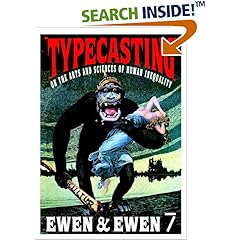
I first came across an interview of (Elizabeth) Ewen & (Stuart) Ewen in I.D. magazine last month. The interview was accompanied by a full page photograph was of a stern-faced middle age couple, the man bearded, and one was seated. Both were wearing (in my memory) dull-coloured patterned sweaters in front of a shelf of books.

What are you thinking when you read this description of them? What image, if any, forms in your mind's eye?

What we see, of course, is also what we have been taught to see. The ideals of beauty, the judgement of chcter, the assignment of racial attributes, the rationalisation of power - it is really quite amazing how much contradiction we actually live with in order to maintain these notions.

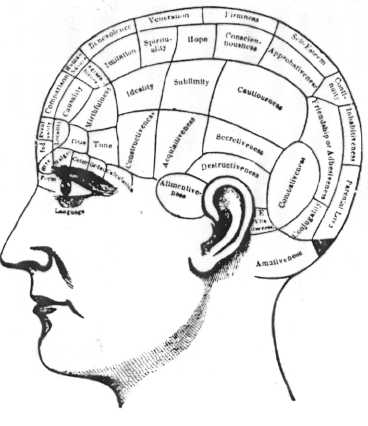
From the the opening pages of historians Ewen & Ewen's book Typecasting: The Arts and Sciences of Human Inequality, the reader is presented with a sweep of vignettes not so much about stereotypes per se, but how we perceive what we see - particularly other persons, race, gender etc - is tied to the evolving geography of power; the forces of urbansation; the sly strategies of the early European and American colonisers; the curious histories of "Curiosity Cabinets"; the rather bizarre rise of physiognomy and cranioloy and phrenology (and noses, of course!); and the continuing complicity of art, science and entertainment.

One chapter on how folks were exported and presented at the World's Fair, "scientific"' shows and even in a zoo, right up till the early 20th century, was disturbing. Even after their deaths, their skins were sent to the taxidermist, their body parts pickled and their skeletons taken apart before being stored in museums - often forgotten. One of the most well-known of such persons being a lady Saartje Baartman from South Africa.

Another chapter on American Orson Fowler (publisher of the first edition of Whitman's Leaves of Grass!) was interesting how phrenology, born in Europe under the guises of science, became a multi-product self-help enterprise in America. In fact, beyond the deterministic theories of the early phrenologists, Fowler departed by admitting a degree of free will and self-determinism, guided by the moral imperatives of an early protestant America. So if there were 2 boys endowed with a similar "cranial potential", Fowler allowed for 1 to choose the way of righteousness and the other could still choose the "downward course". But in one respect, the American phrenologist was consistent with his European predecessors: both insisted that Indian and African skulls - or for that matter, the "Jewish nose" - were proof of the intellectual and moral inferiority of these non-European races.

We don't need a 555-page book (thankfully, there're lots of pictures!) to tell us that ideas of human inequality is perpetuated by those in power. But I guess it is always good to be reminded how easily the very things we love - the images we create, the knowledge we investigate - can be systematically employed in such degenerate enterprise.

Wednesday, August 9, 2006

the measure of a life

3 stooges (扮鬼臉)
J's ma, J's favourite niece, and J's all-time favourite girl.

Y: I wonder how your mom feels.
J: Sad lor. Depressed.
Y: That I know. What I mean is if she looked back on her own life, how do you think she will describe it?
J: Before she got the stroke?
Y: Yah. Before. If you had her life, how would you describe it?
J: Hmm...I think she would have said it was good. She would be quite proud about it. You remember how she is always boasting about how good a mother-in-law people say she is, how she cooks so well, how this son or that is so fillial to her, how this in law or that treats her so good, how she is so polite, how her husband is such a good man... that sort of thing. I think she sees herself and her life as being good in that way.

Last Saturday was Ma J's birthday. Someone suggested that we take her out for dinner. The venue chosen was Sakura, a low budget Japanese buffet place.

Of all her 7 children, only 2 were there - J and his only sister. The other 5 brothers were absent, for varying reasons (one had chosen perform some duty at a taoist temple instead, one had opted to play soccer with his mates, one had to work, two had opted out of the dinner citing financial problems), although 3 were "represented" by their wives and children.

Ironically, much of Ma J's life had revolved around her children and dinner. She had her first child when she was 20 and her last (my J!) when she was in her late 30s.

She never held a job, save for helping out at Pa J's food stall and keeping house. Up till the day she suffered a stroke, she still made dinner for most of her sons. These men in their 40s and 50s would bring their wives and children to their mother's dining table each evening. They arrived at different times of the evening, sat, ate and left.

Before her stroke, a typical day for her would begin in the late morning. She would get out of bed and make a trip to the market with Pa J for lunch and to shop for dinner. In the afternoons, she would nap before waking up at 5 to start making dinner. After dinner and seeing off her children, she would often pick up the phone to call relatives in China or Chinese relatives working illegally in the UK. Once every few years, she would make a trip to China to see these relatives, although every other day she would be talking about travelling there. She would end the evenings lying in bed and watching cable TV. She saw no reason to change any part of her life. She took no counsel. She always spoke what was on her mind.

However mundane all this might seem, most of it she can no longer do, until she regains her mobility. And what she can (i.e. talk on the phone, watch telly), she no longer finds any joy in them or motivation to do so. Now, even if she wanted now to change her life, she felt helpless to do so. Nonetheless she still takes no counsel and she still speaks what is on her mind - even if she seldom even speaks.

So last Saturday's dinner celebrating Ma J's birthday was a particularly depressing affair with only 2 out of her 7 children present, and our unsuccessful efforts to cheer her up. As Ma J blows out the candle stuck into the random slices of cake selected from the buffet, I wonder if it is just the physical effects of the stroke that causes her to lament once in a while "I'm so tragic!" (or in hokkien "我真惨!"). Or is she lamenting a loss she never imagined, for things she thought she had but never really did.

Making her smile...(笑)
She smiles only because of Adobe Photoshop - image by J

Tuesday, July 18, 2006

the very first time

amateur

The first novel is a curious thing. (I've never written one myself, sorry, so I am speaking here only as a curious reader.)

If I was an editor handed a first novel, would I edit out the rawness? The parts that appear over-written but, given the context and the rawness of emotion, those dramatically paused sentences that actually seem wrong in a right way? Would I suggest that the story arc be less obvious, less naive? Instead, suggest that it assumes a more deceptively meandering form so that when the pages towards the end literally thin out, the reader would not be so conscious that the story is reaching a point of conflict that will, no doubt, be resolved?

Oh lucky thing I'm also not an editor!

Still, it is equally hard to be a curious reader nowadays.

The reviews give out the whole deal. The hype that surrounds each book reaches you through the newspapers/blogs, word of mouth, bookcovers that try too hard, and fancy displays in bookstores - that now ubiquitous top 10 shelf. But I was curious when I picked up Khaled Hosseini's first novel, The Kite Runner, mostly because it was about Afghanistan, and I know next to nothing about that country.

And like any good read, while a large part of the novel is set in and the characters are all from Afghanistan, its specific political turmoil is enhanced, not reduced, by the common stories of love, jealousy, shame and absolution. For me, where The Kite Runner rises above the pitfalls of a first novel is most clearly seen in its powerful yet sensitive telling of shame. The shame of betrayal. The shame of cowardice. The shame of un-love. This is no niggly guilty feeling, but the overwhelming, stricken fear that you are not who you appear to be, and that one day, what or who you truly are cannot be hidden, not even from your dream life.


========
*If you prefer to read this in a group and talk about it with random folks and reading clubs, The Kite Runner is also a recommended book for the Read Singapore season.

Thursday, July 13, 2006

hair-brained

In many ways, in spite of meritocracy, democracy or whathaveyou that we put on, it often feels like we are suffering from the weird lingerings-on of a primitive system...

But this is really about hair and hairdressing.

剪 (cut-cut)
Before, During, After...hair art by J

A one-party landscape and a monarchy have these common types - an emperor, the crown prince, a select group of favourite princes/princesses, eunuchs, courtiers and generals...everyone else a tax-paying subject. On a small island, substitute the emperor with a feudal lord and his clan.

In such a world, that rigid, unquestioned hierarchy of occupations also prevail. The way to the top is either to commandeer troops or be a scholar, and rise to be a magistrate, first in the small town, and perhaps to the capital to join the court of ministers. Merchants are respected and disdained for their wealth. Poets drown. Artists (if they survive) must pander to the taste of the emperior and the court, or the lord and his clan - service the legitimising and celebration power with the display of prosperity and human achievement. But hairdressers. Folks who use their hands, service the body or its appearance - thair dressers, ear-cleaners, tailors, artisans, singers - they are at the bottom.

The Cloth Maker (裁縫)

Against this limiting order emerged the liberating, fictional jiang hu - an alternate universe of swords(wo)men, and bad evil villains on the extremes of yin or yang. The jiang hu and its unwritten codes of coduct (not unlike the Italian mafia underground), return compassion and justice to the alienating forces of officialdom (whose bad eggs are often in cahoots with the villains with the red eyeliner and green smoke bombs).

Aiyah, I don't really know why or what I'm ranting and rambling about here. Perhaps it's just been a frustrating week at work, and I almost wish I could, like Terz and Tym, imagine living away from this small island.

But back to hairdressing.

In Singapore, a hairdresser is not something a child dreams of becoming. It is a job associated with low-wage foreigners from across the border or the Middle Kingdom, and Secondary School dropouts. Designers and artists are marginally higher on that ladder. J and I know go to G for our haircuts. After so many years, he's a friend who amazes us each time with some fancy two-headed scissors he's just bought from an 18 year-old master in Japan, a new tale of his new snazzy salon in Shanghai, or some strange concept salon he's been dreaming about.

But hairdressing can be more than an occupation stuck on some invisible ladder going nowhere, it can be an art. And as with most arts, it takes skill, experience, knowledge and understanding - creativity and vision. I remember a conversation with G once about what he does. We talked about texture, fashion, form, perspective and lines, logic and intuition, sculpture, cultures, ergonomics (in the design of scissors!), business, the future and shampoo.

life saver

In the end, hairdressing saved my week.

:: At its start, I learnt about Read Singapore, and the Library Board's initiative with several hair salon owners to introduce a reading club in their salons. What a great idea! Why can't there be a politicians book club? A civil servants' reading club? These are folks who really ought to read more -and not just management books or reports, but fiction, glorious fiction, redeeming fiction of jiang hu!

:: Two nights ago, I invited J to try his hand at trimming a fringe that demands to be trimmed. Tonight, after studying the results, we're going to do more cutting. After all, he has been observing G for almost a decade now, surely he had picked up something! Time for an experiment! (see images above)

:: Yesterday, I chanced upon an article in Forbes that listed the 10 jobs that will disappear, 10 jobs of the future, and 10 jobs that will never go away. Guess what's #5 and #6?(*)

:: Today, I met with Wheyface and orange clouds (back from Beijing). Over a yummy lunch of fish roe spaghetti, what else did we talk about for 30mins but that fascinating art - hairdressing - Japanese haridressers in China, horror perms, selective rebonding, tri-coloured highlights. Even hairy Lee made a guest appearance, courtesy of Wheyface's professorial observations during the conversation.

So long live hairdressing! Long live hairdressers! Long live hairy hair!

--------------
(*) 1 - politician
2 - prostitute
3 - mortician
4 - tax collector
5 - barber ("nothing is certain in life but death, taxes and haircuts")
6 - artists inc. designers, writers, entertainers
7 - parents/parenting
8 - religious leaders
9 - criminal
10 - soldier

Wednesday, June 28, 2006

pass it on

too young to...
i like how yoshitomo's painting "too young to die" is merchandised here as a giant ashtray. we don't smoke so it's used as a tray for vitamins and medication. the irony either way!

I've been sick since Saturday, the most virulent flu-bug I've known and promptly passed to J.

The only "good" thing that has come out of the 5 days was that I managed to finish reading 2 wonderful books which I would, if I could, promptly pass to someone - Nicole Krauss' The History of Love and RK Narayan's Tiger for Malgudi.

That's all for now. I don't think blogging counts as "rest" ;>

Thursday, June 22, 2006

only lines

onward
a mock cover for a book still waiting for its poems

Arthur Yap died on 19 June. The Straits Times wrote a eulogy for the "man of few words" who died of throat cancer, his vocal box removed and replaced with an artificial implant 2 years ago. Like Goh Poh Seng who passed away last year, I read somewhere that he was living apart from Singapore.

He is my favourite Singaporean poet, and after all these years, still the best. I re-discovered him only a few years ago, reading anew when SKOOB published his selected poems The Space of City Trees in 2000. (Arthur Yap is also a painter and the cover art below is his.)

He writes a measured line, but its syntax and cadence - natural, steady - belie an ambivalence - as if to preserve, still, another space, an invisible ellipsis, a hidden parenthesis. And it is these spaces which give his poems endurance, give an open invitation to stay, still, contemplate - perhaps - know. There is seldom a false note or an exaggerated gesture against a social or political narrative - the poems don't read like they need to prove their intelligence or their place in our thin literary history. If at all unreasonable, it is not angry youth. If careful, it is not from being studied, studious - but as Yap wrote in a poem, words are to be stilled, or we are to be stilled by them, whichever. Personal, but never screamingly inward. As from his first collection, this poem -
expansion

no stretch of darkened sky
would show a patch of red
a patch of sunset

where the sun will not stay
after dark
the skyline of houses
grows with the sky
and who can tell
what is this completion;
i cannot chew the month to days
masticate the days to hours
and line the hours each to each
saying, out of context, i die.
where once a single day
was a day and a night
it is now the amoeba of day
of night,
the line of sponge houses
soaks in the sky
as the sponge sky
seeps into the houses.
where once houses hung from sky
they now are clutches.
so one urban expansion
has to lean on another
or they die

while the tree of night grows and grows

(from only lines, 1971)

Tuesday, May 23, 2006

long live reading!

reading is fun 2
click on image to get to the flickr page

Which activity best describes what you do most?
A. writing
B. attempting to publish
C. reading

In a fit of optimism, I sent an edited version of this short story last week to the admirable Silverfish publishers in Malaysia who are in the midst of compiling their 6th anthology - completely misreading the deadline "31 Mar" as "31 May". Aiyah.

Thank goodness there's still reading! Long live reading!

As with last year's poster, today's poster is for you to download and spread the happy news. The government says it's good for you too.

Monday, April 17, 2006

the tiger and the trojan horse

Watching the television "conversation" between the Minister Mentor and a group of 20somethings (mostly journalists), I cannot help but pity the young people in that recording studio. All their years added together cannot match his. As they sought to ask what they had imagined were difficult, awkward questions about his arrogance, his political longevity, the PAP's obliteration of the opposition, did they seriously think that the MM would be trapped by their questions, that he would stumble in his answer, unwittingly reveal a weakness? Or did they imagine that they would be depicted and viewed as anything else but arrogant, disrespectful youths?

If they did, they would do well to read Dennis Bloodworth's The Tiger and the Trojan Horse. The late correspondent from The Observer (Bloodworth died last June) writes a prose as serpentine and faceted as the political drama he observes and records of Singapore's modern history. At times immediate, at times the distance feeds an appropriate irony.

The tiger in the title refers to the Communist United Front in that famous line from the now MM - "We were riding a tiger and we knew it." And the trojan horse refers to the PAP which, of course, denies such strategy - "...Our party does not intend to be the Trojan Horse of the Malayan Communist Party."

Ah, such poetry.

If the characters in the drama had indeed spoken the words Bloodworth accorded to them, then these were men and women who certainly knew their poetry - quite literally.
It was both a bond and a breaking point between coloniser and colonised. When Corridon came to arrest Devan Nair for the second time and was greeted with 'You f..king mercenary!' by the future President, the gap between cop and pre-communist closed as he retored, 'Mercenary? Yes, but don't forget they "saved the sum of things for pay".' For Nair knew his Housman too. One Chinese detainee asked Corridon for the works of W.H. Auden, adding contemptuosly, 'but you'll never have heard of him.' The ever-surprising Corridon promptly recited a few lines to put him in his place. 'You bloodly imperialist,' shouted the anti-colonial subversive, tears starting in his etes. 'How dare you quote from my favourite poem!'(p53)
And just in the page before, the now MM had successfully won an acquittal as legal adviser to the Socialist Club accused of sedition for their anti-colonial article that labelled Malaya a police state in 1954 -
An accompanying photograph shows the acquitted students and Lee Kuan Yew drinking a toast to Pritt and 'freedome of speech'. None saw the irony of celebrating a victory that had been won just because law and liberty had been upheld in a colonial court. For the values of the colonialists were the natural moral environment of these sworn enemies of colonialism - the measure, as Goh Keng Swee might have said, of what was decent.(p52)
So history, too, deals with a deft hand and a crooked smile - those who have dethroned the powerful succeed by the latter's own administration and machinery; so when those who were once the rebels themselves have assumed the throne, they will inherit the same means of exacting control as their retreating oppressors. There will always be tigers to be feared or tamed, and trojan horses to construct. But meanwhile, there are zoo-keepers.

Bloodworth also highlights to his readers the youthfulness of these anti-colonial and/or pro-communist lawyers, doctors, journalists, civil servants and unionists. They were 24, 28, 32... not any older or younger than the participants on last weekend's televised "conversation". But those young persons seemed to be constituted differently - or as the circumstances demanded. So it is clear that what we have today is not a time for political change, when a striped creature and a machine horse might emerge, much less to cross paths. The social democrats (though I think this is no longer the ideological banner under which the ruling party governs?...of course, ideology is dead) have done well to keep their span wide in the right, but ensuring that the social goods are always delivered, grounded in pragmatism and communitarianism. The violence, disorder, injustice and ineptitude of, variously, the Japanese occupiers, communist guerillas and British colonisers are absent. Of course, there are other forms of violence and disorder today - but that is not for this narrative.

As the MM reminded his fellow "conversationalists" on last weekend's television programme - the grand narrative has already been written, their job is only to try to understand it and its reasons for being. Me? I much prefer the enjoyable read Bloodworth produced - written in a style as one would fiction.

Thursday, March 23, 2006

they came, lived, talked (and talked some more)

While having lunch with my colleagues at Earshot, the bookstore cafe at The Arts House at Old Parliament, I took the chance to scan its shelves of Singapore publications and music CDs...and came across this gem - Pioneers of Singapore: A Catalogue of Oral History Interviews (Archives and Oral History Dept, 1984 - now called National Archives of Singapore).

pioneersbook
Check out this pre-Adobe Photoshop cover where you can see the crude edges of the cut-out lady/computer in foreground.

To be sure, the book is nothing more than what it honestly states in its subtitle - a catalogue. It does not contain the actual stories. It is not a transcript of the recordings. It does not even have photographs of the interviewees.

A colleague who flipped through its pages wondered why anyone would purchase this, well, boring book. Of course, there are fools like me.

Try this extract on civil servant Mr Sng Choon Yee (b.1897):
R01Family background. Early education in Chinese classics. School fees. School hours. R02How his eldest brother helped other scholars to pass examination...Recommended his father to a tax collector's job. R03His father infected by cholera.
Mr Sng, by the 4th recording, got to the story of his family's journey to Singapore. In his 6th and 7th recordings, he spoke about his school life at Gan Eng Seng School and how he had organised a strike in school to protest against praying in the rain, how he compained to each trustee of the school. He switched to Raffles School (yes, even in those days, civil servants had already hailed from that institution!). There are 24hours worth of stories from the anti-Japanese days, the China Reflief fund, mention of Tan Kah Kee and Lim Nee Soon, the printing of the Sin Chew Jit Poh (Chinese newspapers), the transport system in China Town.

Or the less chatty Forwarding and Security contractor Mr H J C Kulasingha (1900-1982), who had left his home town in Ceylon for Singapore and eventually started his own business in 1946. In his 4th recording, he spoke about
Reason for closing of company in 1967. How he got the name "King of the Islands". His public service activities. Interest in politics. Involvement in Progressive Party. 1951 Election campaign...
And what else did Mr Kulasingha contribute to? He was a Director of the Jurong Bird Park!

While this catalogue does nothing more than provide these "headlines" on the lives of these pioneers, I was amazed how eventful (I cannot think of any word but this) , even when recounted only in short phrases, the lives of these men and women were! In fact, I think I quite prefer it told this way. These bits and pieces, these skeletal fragments, leaving the skin, flesh, organs to the curious imagination - and to fiction.

============
Lucky tym actually gets to listen to these archival recordings as part of her job! Oh, envy!