Showing posts with label singapore. Show all posts
Showing posts with label singapore. Show all posts
Monday, April 19, 2010
the wise and the foolish
...the same fate overtakes them both.
One evening on bus 145, I overheard this conversation. Well, there was no need to strain the ears because the conversation between the two strangers was louder than the bus engine. It was like a performance, and everyone else quickly quietened down to watch -
[The conversation in Mandarin. Old Man in a blue short-sleeved shirt sat near the front door of the bus. Old woman, also bespectacled, was standing beside Old Man's seat. Never once in the conversation did she look at him. They both wore smiles throughout. ]
Old Man: The next time you vote, I hope you vote the opposition party.
Old Woman: I don't need to vote.
Old Man: Why not? Everyone must.
Old Woman: Aiyah, I don't need to. Where I live, always don't need to vote.
Old Man: But next time, if you vote, must vote opposition party.
Old Woman: The next time? I'll be dead by then!
Old Man: You can't say that. The opposition is good. Vote for them.
Old Woman: Aiyah, whatever. Man must work. Man must eat.
Old Man: Yes, that's why you work so hard, you should enjoy -
Old Woman: Man must eat...
Old Man: You listen to me, I tell you -
Old Woman: Man must shit.
Old Man:[...] You work so hard, why must you give the Government all your money? That's why the opposition party -
Old Woman: Aiyah, I don't care what about this party, that party. I only want the Money Party.
Old Man: The opposition party won't take your money. Everything will be free. Like in Canada, Europe...
Old Woman: Why do you bother so much? There's no difference.
Old Man: You can, you can be like me. Next time you see anyone, just tell them to vote the opposition party.
Old Woman: Aiyah. Whatever will be will be. I tell you. It's like this heavy rain. It wants to rain, it rains.
Well friends, that's the latest report on political discussion in Singapore. Most of the time, the stifling humidity feels somewhat oppressive. And once in a while, it pours - though sometimes, the rain simply raises an equally unbearable heat from the ground.

Monday, March 29, 2010
truth or dare

I've shortlisted only 3 films from this year's Singapore Film Festival. A record low! The truth is, without a physical programme booklet and the website's tedious navigation, I gave up after two rounds of reviewing the programme online. But I guess my cautious approach is entirely in line with this year's rather flat (*yawn*) programming:
- Yan Lei (Tears), directed by Cheng Wen-Tang
- Dear Doctor, directed by Miwa Nishikawa
- Jao Nok Krajok (Mundane History), directed by Anocha Suwichakornpong
Friends, may you possess more daring in clicking on the "Buy Tix" button.
Tuesday, March 23, 2010
culture coming out of your s/pores

It's the "Arts and Culture" issue of online journal on historical and contemporary Singapore society! Guest edited by Tan Tarn How, Part 1 of this issue features:
‘After’ Kuo Pao Kun › C. J. W.-L. Wee
For wolfnotes › Lee Tzu Pheng
Third Stage › Wong Souk Yee
“But there is nothing here to shoot…” › Tay Kay Chin
Raising the Subject › Jason Wee
Censure and Censor › Loretta Chen
National Songs Revisited › Tan Shzr Ee
First-World Economy, Third-World Culture › Michelle Loh
Review: +65 Indie Underground › Joseph Tham
Click here to read an issue that's really diverse which, given its theme, is apt.
Sunday, February 21, 2010
applause

At 陈珊妮Sandee Chan's Esplanade performance (as a friend CT puts it, it's been a more than 10-year wait for fans on our island!), she used the words 認真 to describe how she had selected the songs lined up for last evening's fantastic concert.
Most online dictionaries define 認真 as "serious", "earnest" and "to take seriously." The problem with Chinese-English translations is that the word often means all of this and more. 認真 suggests a degree of genuine care that is less removed than seriousness and more calculated than just earnestness.
I would like to think that the folks behind Friday night's play Invisibility/Breathing, also at the Esplanade under its HuaYi Festival, were equally 認真. There was a precision and detail in actor Oliver Chong's performance that warranted the adjective. And despite the work's weakness, the same professional dedication was apparent in the set design and construction, the sound and direction.
All of this makes the weak applause - particularly at Invisibility/Breathing - rather depressing.
Friends, the next time you attend a performance, be it a play, a dance or a concert, if you recognise that what happens on stage is taking place with the utmost of dedication, thought and craft of the performer sustained over an hour or even two, please do not be stingy with your applause. It won't cost you much.
Thursday, February 4, 2010
post-it

J designed the event's logo this year. :>
If large canvases are not your thing, you may want to check this out!
In its 3rd edition, Pameran Poskad is, as its name reads, an exhibition of art that fits into postcard-sized plastic sleeves. It's been an interesting "egalitarian" platform so far, with work by really established artists placed next to amateurs from around the world. Started by fine art printmakers Keyakismos (Eitaro and Tamae), this year's exhibition already has close to 150 participants.
Even if you don't fancy yourself an artist type, you can go spend some of your Ang Bao money at the show from 17 April to 1 May. Heh.
Saturday, October 10, 2009
the wake-up bird

Several weeks ago, I blogged about the calls of the wake-up bird. It has plagued me since. Not the calls per se, which I enjoy for the way they enter the HDB soundscape of bus stops, chittering mynas, chattering children and the incessant varied noises from the nearby taoist temple. But rather just identifying the bird itself.
Not satisfied with mystery, I've since been searching online recordings of bird calls. But with no real clues, it got as desperate as googling "whoo-ooo bird call". At one point, we even thought it could be the frantic call of the monkey that has wandered from the pierce reservoir and spotted hanging around our street.
But a monkey it is not.
Last afternoon, J finally spotted the creature perched on the top of a tall tree, issuing its loud "woo-ooo" uncharacteristically at noon. Ah, it was a large black bird with a distinctive tail and a beak that did not look like that of a crow's . That helped narrow down the options. From descriptions and photographs in the "Guide to the Common Birds of Singapore", it could either be a house crow, possibly the nightjar or a bulbul, or the greater coucal. The greater coucal is from the cuckoo family. And it seemed to make sense that it was some kind of a cuckoo bird. Unfortunately, after 2 hours of online searching, none of it sounded like our wake-up bird.
Just when I was about to abandon the search, one of the random references from "greater coucal" on youtube read "Asian Koel". It was something about the sound of that word "Koel". I clicked - and heard that familiar call. Ah. The wake-up bird.
Video by Diana57 in Singapore of a male koel calling out for a mate.
Sound of a female koel, by tankavideo
Avianweb.com's page on the Asian koel identifies it as a bird in the cuckoo family. It is also known as the "Rainbird" in Australia, while its name "koel" means "nightingale" in India. In Toa Payoh, I think the koel shall remain known as the wake-up bird.
======
p/s. Here's a video of a mating dance between two koels. The male is black and the female is the brown and white-spotted.
Sunday, October 4, 2009
island biography
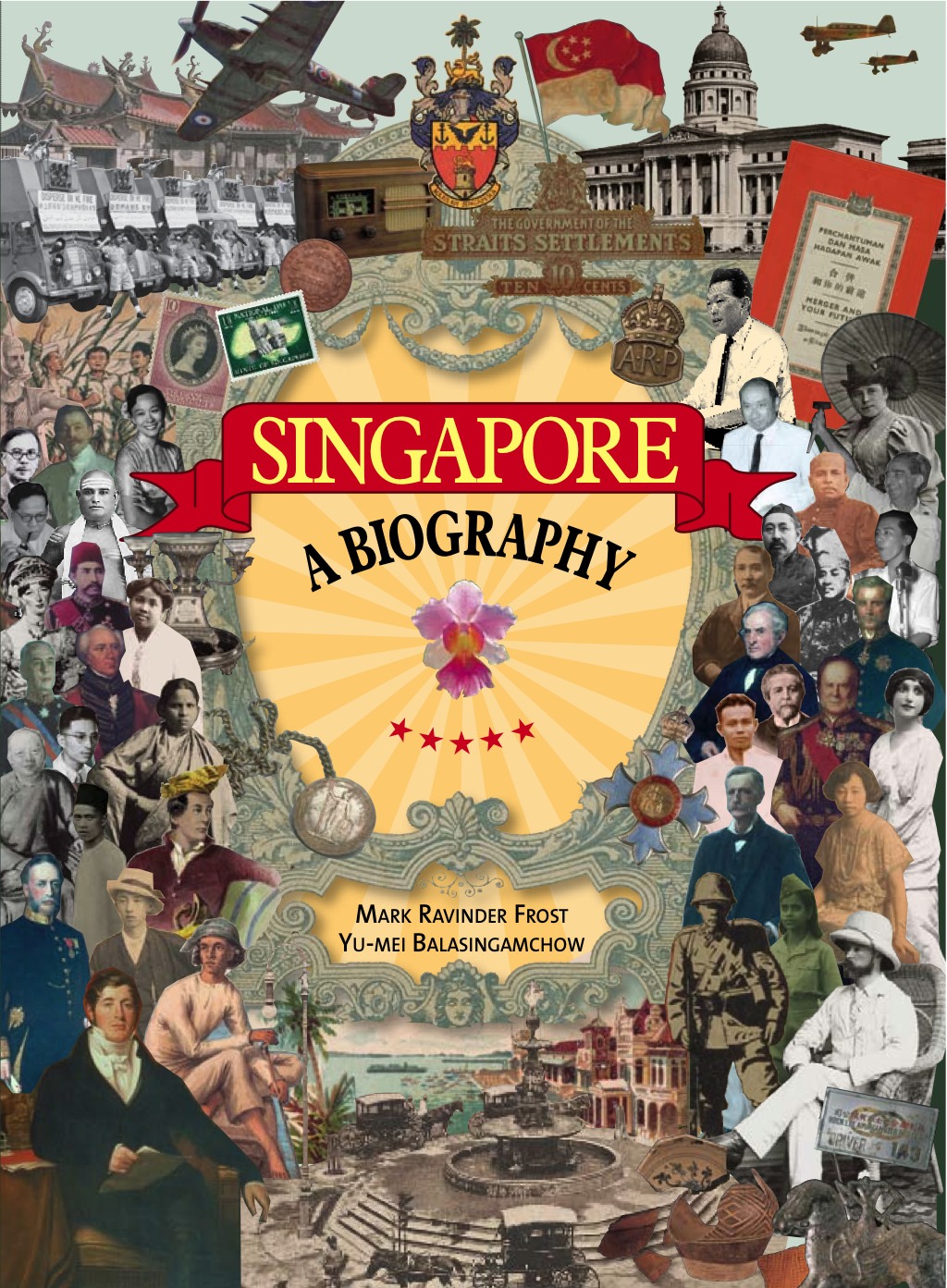
Check out this book by tym and Mark Frost about the lives that made our favourite island in the tropics! From the previews so far, the book promises to be a great read.
There are 4 things amps recommend that you do:
(1) Read the previews/snippets from the book and the writers' posts here.
(2) Buy your copy from the bookstores, or pre-order one. Of course, proceed to read it!
(3) Attend one or all four of these events where the writers will talk and gamely sign your copy of the book.
(4) Buy another copy for a friend.
Friday, September 11, 2009
trumpet tree viewing

images by J
From our fifteenth floor flat, we can see the top of trees - their varied shades and flowered crowns.
In the month of September, or round about the seventh lunar month, the trumpet tree (I think that's what it is) blooms and rains down its flowers.
J: It's our cherry blossom!
Y: Yah, like cherry blossoms! Pretty ah.
Old woman: [in Hokkien] Super pretty.
Y: [in a semblance of Hokkien] Very pretty.
Old woman: Every year around this time, these trees are like this. Sometimes all the way until the eighth month.
Y: Is it?
Old woman: This morning, wah, the ground was all full of flowers. They sweep it away already, But this morning, wah. Super pretty.
Y: If you look down from the window, the whole tree top is flowers.
Old woman: I can't go to the window ah. [gestures at the wheelchair] My legs are no good, afraid I'll fall.
Y: Yah, better to be careful...
Old woman: [sits watching the flowers while we walk off] Super pretty.


Sunday, August 30, 2009
to see the world and the living room

This being the weekend when Singaporeans are busy booking their year-end packaged holidays at the travel fair, it is apt that J and I overheard bits of this conversation (well, it's more like a monologue) at the Kiliney Road Kopitiam -
Woman: Yah, when I was in Hokkaido last year, it was hard to find this
Hey, 700 square kilometers is pretty large an island to have to trek around for folks who prefer to lug around a suitcase.
Unfortunately, save for our rather obsessive bike rides to this, us amps cannot claim to have contributed much to domestic tourism this year as well. But Saturday evening, we overcame our inertia to find our way to a part of the island we seldom venture to - Bukit Timah. Or to be precise, Upper Bukit Timah.
If Katong was our genteel east, where old money built their seaside homes and breathed a little easier, then Bukit Timah is where they eventually landed their wealth. Unlike the east, whose refinement got reclaimed together with the shoreline, Bukit Timah continued to be where their grandchildren (or those aspirational families) continue to populate the bungalows and condominiums and patronise the fancy "specialist" grocers and butcheries. Well, it's therefore not surprising that ever since my junior college days and a brief stint volunteering at the old Salvation Army Store's sorting house, Bukit Timah is a part of the island J and I don't have much reason to frequent. But we found one to warrant a Saturday evening bus ride from Toa Payoh to Upper Bukit Timah Road.

random shot off from a cab across the island.
We got off bus #157 at the Bukit Timah market and hawker centre. That was not the reason for the bus ride (at least not this time), and neither was it the old skool Beauty World Shopping Centre and Bukit Timah Shopping Centre. So we headed past both shopping mall
The cluster of low-rise buildings that used to be the Bukit Timah Fire Station was turned last year into another one of those hip "lifestyle" places, a la Dempsey and Old School. This one houses several offices, schools that teach stuff like photography and digital arts, a spa, a bistro called *surprise* Fire Station... and our destination - Raw Kitchen.
Housed in a single-storey unit in the innermost corner of the whole compound, Raw Kitchen is nothing if not charming. That night, all the chairs in this small, owner-run restaurant were placed in its backyard where Substation's associate artists, collective Mux were giving a performance. For more than an hour, we sat, sans dinner, just relaxing and listening to this group of very young, talented folks:
We shot this on the iphone, but you can watch a recording of their performance specially by Common People made in a living room by clicking here. If you want to get out of your living room to Raw Kitchen, it's at 276 Upper Bukit Timah Road. Warning: It's not a live music place, in case you are mistaken.
====
*Place names in Singapore
Sunday, August 23, 2009
birdsongs


Over the weekend, J and I went with tym to check out the "Curating Lab: 100 objects" project under the Singapore Art Show. The first object was of a series of blown-up 1960s newspaper clippings from artist John Low's collection. Other than sightings of the "Oily Man", "beast in Serangoon Gardens" and ghosts in cabdrivers' backseats, there was a kind of non-article (if there was ever such a thing as non-news, this would be it) about some kampong residents' alarmed sighting of a "death bird" and its call. From its description, the "death bird" sounded just like the common house crow. Perhaps they were less common in the 60s. If so, maybe it is not too difficult to imagine then how a lone crow could possibly alarm a kampong with its aggressive cawing and its seemingly ominous haunting.
Round about eight in the morning, a bird in the cluster of trees by our block of flats will issue a series of loud echoey calls - "whoooop whooop". A couple of mornings ago, I woke up hearing just that loud call; and drifting in and out of sleep, all that filled those brief in-between moments was the bird's call. A kind of audio-only dream.
How would you describe the calls and songs that birds make? Pigeons coo. Crows caw. Mynahs, those comical birds with their random head shaking and awkward hopping, they make these appropriately untuneful clicks. And hummingbirds hum?
It is hard to forget Murakami's description of the "wind-up bird":
There was a small stand of trees nearby, and from it you could hear the mechanical cry of a bird that sounded as if it were winding a spring. We called it the wind-up bird. Kumiko gave it the name. We didn't know what it was really called or what it looked like, but that didn't bother the wind-up bird. Every day, it would come to the stand of trees in our neighbourhood and wind the spring of our quiet little world."
Then there are the more prosaic but no less curious descriptions in Clive Briffett's A Guide to Common Birds to Singapore (part of this series of pocket-sized books published by the Singapore Science Centre that I am addicted to), such as:
...it issues a monotonous two note whistle "coo-oo" fairly regularly every two seconds and has been likened to a demented hiccupping! (Brown Hawk Owl)
Often calls attention to itself using a raucous call followed by a noise resembling a whinnying horse as it sits on overhead wires (White-throated Kingfisher)
Frequently issues a noisy shriek resembling a saw grinding against metal (Collared Kingfisher)
...listen for the distinctive call of "whats it" or "peepit" issued in flight (Asian Fairy Bluebird)
...has a "chwee chewee" call with an alarm note resembling a "tissyip tissyip" (Richards Pipit)
I've been listening to online recordings of bird sounds for the past hour, hoping to find the name of my morning alarm clock. But until I recognise it, I think it'll just bear the unflattering name: the wake-up bird.
========
p/s If you want to listen to an actual bird songs in Singapore, there's actually a CD recording Bird Songs of Singapore at the National Library (Lee Kong Chian Reference section.
Tuesday, August 18, 2009
soft spots

screen capture of website
Vote
If you've time this weekend, make a trip down to the Singapore Art Museum where there's a show of works by Donna Ong, Vertical Submarine, Felicia Low and Twardzik-Chng Chor Leng - the four artists/collective selected to be this year's President's Young Talents. Alternatively, it's probably worthwhile to time your visit with the curator-guided tour, conversations with the artists, or better yet, to observe or participate in one of Felicia Low's workshops.
This year's exhibition includes a "People's Choice" segment, where you can vote for the artist whose work you most admire. I must confess that none of the works blew me away, although Donna Ong's sculptural installations are - as always, to me - considered and rigorous in both construction and thinking. But I've always been biased towards artists who have a direct engagement with the society around them, and who have an inclusive approach towards their art and audience. For this reason, my click on the vote button is likely to be next to Felicia Low's name - not just for the exhibition, but the work she seems to do daily.
You can view videos of the artists and their work, and submit a vote at this website. *shameless promotion for J* ampulets design did the environmental and communications design! I think it's great, another bias.
Give
I've a soft spot for this space. But after 2 years providing its space for artists and various NGOs to meet, collaborate and present their ideas, the Post Museum now needs your contribution!
Click here to find out more about how you can give to. For starters, some projects that are easily identifiable include its hosting of the "Green Drinks" project; as well as its organisation of the "Soup Kitchen" project and Singapore Really Really Free Market. Of course, you can also help support the work it does more directly with artists by supporting its residency or exhibition programmes.
If all that sounds too daunting for you, you can also have a healthy vegetarian meal at its cafe, Food#03.
Friday, July 17, 2009
pass it on

at the top - image by J
"Succession planning" is one of many examples of management-speak that always make me cringe. It's prosaic enough, but "succession" is a word more often paired with "throne", and word-association moves on to give me "dynastic", "cronism", "privilege" and ultimately "undeserved". But for someone leading an organisation not to be actively looking out for folks who can eventually take over and run the organisation, often better, also suggests myopia, pride or just plain irresponsibility.
In this area, arts organisations in Singapore don't have a great track record.
I recall telling J how optimistic I was feeling about the SIFF, simply because a new team had taken over this year. Finally, an organisation in the arts that got it right by taking the risk, letting go and taking on new and different people, ideas and energy for the longer journey. Maybe my optimism was misplaced... but I am still hoping something good will nonetheless come out of it!
And on that note, s/pores - new directions in Singapore Studies, an online journal, is unafraid in taking on a new look, its first 1st guest editor, and some new writers. So unafraid it is that it is celebrating all this at Food#03 at the Post-Museum this Sunday, 26 July, 6.30pm.
So friends, if you have not read S/pores, click here to read Issues 1-3. Better yet, if you have never been to Food#03 for artist-chef Tien's vodka-yakult or good-tasting vegetarian menu, do so this Sunday - and you'll also get to chat with the folks behind s/pores.
======
p/s Click here for directions to Food#03 at the Post-Museum.
Tuesday, June 30, 2009
help!

"go take my online survey...or I'll slaughter you"
It's been a year away from work. Well, student life is coming to an end in a few months' time, and I'm wrapping it up with a dissertation on independent art spaces in Singapore (e.g. spaces like good ol' Substation and this, among others.)
So friends, I'll appreciate it if you can take a few minutes to complete an online opinon survey about art spaces in Singapore. There're about 9 multiple-choice questions. I'll be sure to update you about some of the findings at the end of the month.
Click here now to take survey.
Thursday, June 25, 2009
here, not there
After Transformers on Wednesday, I can confidently say Here was definitely more enjoyable. It was playful and beautifully filmed, playing up the density of nature and the cold concrete of the hospital. Friends, if you are thinking of visiting the cinema today, why not spend your 90minutes and $8.50 on a film by Singapore artist and filmmaker Ho Tzu Nyen at the Picturehouse/Cathay?
Warning: Spoilers ahead

Here's film-within-a-film (within-a-film...) structure is not new. But it did give rise to some interesting devices. The mockumentary and multiple "videos" made of and by the mental patients constantly shift the audience's gaze, keeping our curiosity about the screen. In one transition, the closeup of a tree outside a window blurs seamlessly into what an impressionist rendering of the image would be, a sublime moment of nature, colour and transformation that takes the viewer in.
Another device of introducing each character via a shot of their signature on a consent form (consent for participating in the "documentary") takes place throughout almost 90% of the film. This serves as a kind of default opening credits. Of course, this could mean that the film that we are watching is, in effect, only the repeated opening and closing sequence of the lead actor killing his wife, followed by his arrival at the Island Mental Hospital.
This loop of action and arrival - is it meant to reflect the mental patients' state of being trapped in their particular moment of criminal action or obsession? Or is it in fact reflective of their conscious choice to remain in their "here" and "inside", the safe "island hospital" where they are happily drugged and made to perform repetitive tasks that aim to condition them for the world "outside"?

"The island hospital", supposed to be previously an actual asylum. Photo taken from here
For J, the film was rescued from contrivance by the "non-acting" of the amateur actors, giving it the charm of a mockumentary. Plus you can't deny the humour with some of the characterisation and situations. The wannebe-actress auntie and the toastmaster man...J recalls and impersonates over lunch today.
But for me, there are places where the film's cleverness inevitably runs into contrivance. Scattered through the film are the usual predictable references to the state of being "here in Singapore", an island. The hospital assistants are dressed in a white shirt and trousers, held up by a black belt (*yawn*). The hospital is called "Island". The patients fantasise about being watched by an abandoned house on a hill. The cleverness of the film is, of course, whether the patients' paranoia reflect the state of paranoid fear among us islanders, or whether the audience's reading into these signs is itself a sign of our self-reflexive paranoia. Are we reading too much as an audience? How much is this a critique of the audience's condition "here" on this island, a conscious choice to remain in a safety zone?
At the end of the film, the narrative suggests a romance instead. We are first prepped for this by the nostalgic strains of 80s song <我找到自己> by Liu Wen Zheng, a musical cue borrowed from Tsai Ming Liang's inspired use of Ge Lan's music in his films. The final shot, resting on a female mental patient (acted by Jo Tan), confirms their enduring and redemptive relationship. Perhaps the decision to settle for a sort of emotional resonance provided a necessary balance and relief.
And so expelled back out there, we were able to go for a late dinner of fish and chips.
==========
For an interview with Ho Tzu Nyen on his film, see this blog and here. Criticine also features another interview.
Post-script: Singapore comix found this journal article about the day release scheme for patients at the previous View Road Hospital, where the film was shot.
Warning: Spoilers ahead

Here's film-within-a-film (within-a-film...) structure is not new. But it did give rise to some interesting devices. The mockumentary and multiple "videos" made of and by the mental patients constantly shift the audience's gaze, keeping our curiosity about the screen. In one transition, the closeup of a tree outside a window blurs seamlessly into what an impressionist rendering of the image would be, a sublime moment of nature, colour and transformation that takes the viewer in.
Another device of introducing each character via a shot of their signature on a consent form (consent for participating in the "documentary") takes place throughout almost 90% of the film. This serves as a kind of default opening credits. Of course, this could mean that the film that we are watching is, in effect, only the repeated opening and closing sequence of the lead actor killing his wife, followed by his arrival at the Island Mental Hospital.
This loop of action and arrival - is it meant to reflect the mental patients' state of being trapped in their particular moment of criminal action or obsession? Or is it in fact reflective of their conscious choice to remain in their "here" and "inside", the safe "island hospital" where they are happily drugged and made to perform repetitive tasks that aim to condition them for the world "outside"?
"The island hospital", supposed to be previously an actual asylum. Photo taken from here
For J, the film was rescued from contrivance by the "non-acting" of the amateur actors, giving it the charm of a mockumentary. Plus you can't deny the humour with some of the characterisation and situations. The wannebe-actress auntie and the toastmaster man...J recalls and impersonates over lunch today.
But for me, there are places where the film's cleverness inevitably runs into contrivance. Scattered through the film are the usual predictable references to the state of being "here in Singapore", an island. The hospital assistants are dressed in a white shirt and trousers, held up by a black belt (*yawn*). The hospital is called "Island". The patients fantasise about being watched by an abandoned house on a hill. The cleverness of the film is, of course, whether the patients' paranoia reflect the state of paranoid fear among us islanders, or whether the audience's reading into these signs is itself a sign of our self-reflexive paranoia. Are we reading too much as an audience? How much is this a critique of the audience's condition "here" on this island, a conscious choice to remain in a safety zone?
At the end of the film, the narrative suggests a romance instead. We are first prepped for this by the nostalgic strains of 80s song <我找到自己> by Liu Wen Zheng, a musical cue borrowed from Tsai Ming Liang's inspired use of Ge Lan's music in his films. The final shot, resting on a female mental patient (acted by Jo Tan), confirms their enduring and redemptive relationship. Perhaps the decision to settle for a sort of emotional resonance provided a necessary balance and relief.
And so expelled back out there, we were able to go for a late dinner of fish and chips.
==========
For an interview with Ho Tzu Nyen on his film, see this blog and here. Criticine also features another interview.
Post-script: Singapore comix found this journal article about the day release scheme for patients at the previous View Road Hospital, where the film was shot.
Monday, June 22, 2009
look and learn

the water that we (eventually) drink - photo of lower peirce by J
The school holidays are coming to an end. Marianne Suresh* (13) and her cousins, Ignatius (11), Victor (10), Jacinta (8) and Julitta (6) have been spending most of it at their Grandmother's flat at Ang Mo Kio Ave 1, and clearly running out of things to do. Between helping grandma make dinner or her suggestion to Marianne to "bring your cousins to the reservoir and see the monkeys?", the latter won more votes.
The reservoir is not far away. Marianne can see the mass of trees from the 10th floor corridor where her Grandmother pointed out the traffic junction where she would find the road leading to the reservoir.
It was early evening last Friday when J and I bumped into their little excursion as we, too, took our bicycles to the Lower Peirce Reservoir. We cycled on the path along the periphery of the reservoir, until it ended at a little bridge that led to the golf course nearby. The famous five had also gathered there, having a mini-conference in front of a sign with a waterdrop mascot that introduced the reservoir as "millions of drops of water like me".
"Excuse me," Ignatius walked towards J. "Where is the reservoir?"
"Er - This is the reservoir - " J gestured at the large, clear jade body of water we were standing beside, the supposed source of the Kallang River.
Ignatius and, by now, Victor and Marianne looked at us silently with disbelief for some 2 seconds. Behind them was a 20 by 20 metre concrete pool, exposed and dry. Their eyes told us they thought J was trying to pull a fast one.
"This - " J pointed again at the landscape before him, "is the reservoir."
"Thank you..." Ignatius offered blankly.
They ran back to the sign and wandered closer to peer at the empty concrete pool. Two minutes later, having exhausted their interest in the mysterious "reservoir" that was empty, they would continue onto their next task.
"Excuse me uncle." We heard behind us and turned around to find Julitta. "Excuse me uncle, where are the monkeys?"
"You see those trees there?" I pointed at a spot diagonally across the water, while Uncle J was busy looking amused.
"Yah, there?"
"If you walk there, the trees over there - there's a wooden path for you to walk on - maybe you'll see monkeys."
"Thank you!"
Then off they went, hopeful that they would find the very creatures J and I would rather not bump into.
And so we learn, to recognise the things we are already looking at but do not see. And sometimes, we may need to see and experience the thing on our own before we come to recognise it.
====
*Their names and context are made up.
Sunday, June 7, 2009
the more (you keep) the merrier

100yen to store the world. All images by J
The impulse to acquire starts with the fear of having nothing, but the impulse to collect becomes the fear of not having everything.
Barbara Flanagan wrote an interesting article "To have and to hold" in last month's I.D. magazine observing the creativity and energy - particularly that of America - that goes into designing storage solutions. From the 20cm long tupperware to the 20foot wide shipping container, she reminds readers that what started as the go-west pioneers' need to stockpile for winters and that rainy day, eventually became a suburban romance of self-sufficiency in the 1950s and today's enslavement to acquiring things that are desired but not needed:
New items categories of acquisition demanded new storage concepts, as items from the outside world moved inside: contractor-grade power tools, gym-quality exercise equipment, commercial kitchen appliances, hotel-scale furniture, and theme park-like lawn inflatables for Christmas.In fact, the design of bigger and more efficient "containers" encouraged more acquisition.
But I have no complaints about one of the largest storage solutions humans have sustained - the water reservoir.

Last Friday, craving for roti prata, J and I decided to take a few hours off work for a midday cycle from our flat, across, Braddell Road through the parks of Bishan to Upper Thomson Road. From there, it's a slight incline past the Lower Pierce Reservoir (phew, no monkeys by the roadside!) to the Casurarina Road prata house where we loaded up on carbohydrates.
 Perhaps seized by a post-lunch guilt, we decided to take our bicycles down the Old Upper Thomson Road to Upper Pierce Reservoir. It was a 20minute cycle, but on that long, windy and hilly road (oh, the return journey would be breeze) where we were occasionally overtaken by black cars of the European variety and distracted by two large black-and-turquoise butterflies, 20 minutes sometimes felt like eternity. Once there, it is difficult to leave the shade of trees and the sight of the surrounding nature reserve (yes, ignore the visible edge of a golf course) intercepting the seemingly endless body of water.
So friends, if you have the chance to take a morning or afternoon off on a weekday, amps recommend that you make your way slowly along Old Upper Thomson Road to the Upper Pierce Reservoir. The experience may convince you to adopt Barbara Flanagan's "owning less, but living larger".
====
p/s If you do make it there, remember: DO NOT FEED THE

Sunday, May 24, 2009
a night ramble

portrait of J against Chinatown's words of wisdom
It was a warm night. But otherwise, a perfect night for a ramble.
J and I met with L at an art exhibition opening by the folks who work at the Singapore Tyler Print Institute.
So for sure, we started at the exhibition at a Spottiswoode Park Road conservation shophouse. But looking at the street directory and Google Earth now, I can't quite plot the exact path of our walk. We must have meandered along Cantonment Road, Kampong Bahru, Neil Road, Bukit Pasoh, Craig Road, Keong Saik Street, backtracking several times and stumbling upon an underpass that led to a little park of swordsmen and women behind the Duxton Plains construction, before reaching -
"The first swimming pool* in Singapore!", L introduced.
"Wow -" J immediately whipped out his Ricoh.


The Yan Kit Swimming Complex was, without a doubt, the highlight of our night ramble. To be accurate, it is actually the second public pool in Singapore, opened in 1952. (Sorry, L) *The first was Mount Emily swimming pool, opened in the 30s by the British.
Located on a sliver between some Tanjong Pagar HDB flats and Yan Kit Road, the low, plain structure was unadorned, except for its porthole-shaped windows and a fringe that indicated its flat roof. The ticket counter was right by the entrance, and hence clearly visible. No double-volume atrium with electronic ticket machines here. Through the gated entrance, it was a maze of abandoned concrete to me. But L pointed out the sides of the empty pool and the mirrors of the changing rooms at the other end of the complex. My imagination forbade me to look. We walked to the end furthest from the entrance where, through the portholes, they saw a small resting area that overlooked the pool.
Its architecture spoke of a more modest time - and a more human-scale.
"I think people were much shorter then," I said somewhat longingly, but was ignored by all 1.78m and 1.82m(?) worth of J and L.
Unlike L, J and I never knew of a swimming complex in this district. For us, there is no memory and hence no occasion for nostalgic reminiscence. If there was a sense - even for a slightest moment, of being in a time warp, it was from the almost immaculate state of the 50 year-old complex in the dark.

The signs read "Meeting Point" and "Low Pipes Ahead"
After dinner at the Maxwell Road Food Centre, we crossed South Bridge Road to reach the quiet shuttered streets of China Town, eventually emerging at the busy thoroughfare of New Bridge Road. My watch said half past ten, but thankfully, this little cafe at the 3rd floor of a shophouse was still open to offer us the hospitality of air conditioning, music and ice coffee.
"Tonight would be perfect if the temperature was...hmm, maybe 10 degrees lower." I huffed at one point during a slightly inclined path.
L seemed to agree, but after a moment or two, added - "I think just 3 degrees will do."
Otherwise a perfect night ramble.

J and L, night poses.
Saturday, May 2, 2009
commonfolk

screenshot of their main site
Common People is a new online archive of video interviews with folks working in/through art, design, fashion, community...or just "people who constantly create and make things happen in Singapore, for Singaporeans. These people combine thoughtfulness, a sense of craftsmanship and sensitivity to their context to create stunning and relevant work" (see their blog for more details). Friends, click and bookmark this for updates!
Wednesday, April 22, 2009
remembering

lyrics from the folksong 青春舞曲 should read 我的青春小鳥一樣不回來.
It was 2002. I was in Hong Kong for a work-related visit. I don't remember where exactly in Hong Kong it was or what led me there, but there I was, in the audience of a kind-of remembrance event on the passing of Singapore theatre practitioner Kuo Pao Kun. A mic was set up in front of the small auditorium. The carpet and curtains were a deep dark blue. There may have been a lit candle (but memory plays dramatic tricks). A group of Hong Kongers were in the audience. There were some speeches in Cantonese.
Recent discussions about LKY's legacy, civil society (ah, the AWARE saga) and an arts NMP brought back memories of this experience in Hong Kong, as well as those very brief, by-the-way encounters with Mr Kuo. I wonder if younger folks on this island will remember and study his works? Because it was reading Kuo Pao Kun's Papers and Speeches, Volume 7 from his Complete Works (ed. Quah Syren, World Scientific Publishing) that made it clear why he is often missed - not just as a dramatist, but as a kind of cultural voice, the closest we get to a public intellectual.
Perhaps his plays, essays and speeches come across as powerful because they carry with them an equivalent weight in action and in a life well lived. He thought, he wrote, he felt, but he also interacted, taught/mentored, acted on his vision, and influenced and inspired private individuals and public officials to contribute. In addition to his plays, he founded the Practice Performing Arts School, the Theatre Practice, the Substation (this island's first independent art centre), and the Theatre Training and Research Programme.
 It is 2am and I realise now I was being too ambitious in wanting to highlight some of the observations about the arts, culture and civil society he has made! Far wiser to simply recommend the 10-volume complete works, including the 7th volume containing his essays and speeches. There is also Kuo Pao Kun: And Love the Wind and Rain (image left), a 2002 volume with a few of his essays, some recordings, and the reflections of his peers and other artists. The books are guaranteed to start you thinking... and hopefully, acting! After all, Kuo Pao Kun's most quoted phrase (the title of an essay/article he wrote?) is "Better a worthy failure than a mediocre success".
Monday, March 16, 2009
island ecology

 Over the weekend at the Natural Sciences shelves of Kinokuniya, I chanced upon over thirty titles of pocket-sized guides published by the Singapore Science Centre from the late 80s- 90s on various aspects of plant and animal life on this island.
Unable to resist, I bought A Guide to the Threatened Animals of Singapore (1st published 1995, reprinted 1998) edited by Peter Ng and A Guide to the Wayside Trees of Singapore (1st published 1989, various reprints since) written by Wee Yeow Chin. They've both been hard to put down.
 Imagine these storied names...the Missing Marvelous Katydid, the Silver Forget-Me-Not, the Saint Andrew's Cross Toadlet. Or consider the sad gaze of this stuffed Banded Leaf Monkey at the NUS Raffles Biodiversity Museum, supposedly one of two subspecies of mammals found only here (image from WildSingapore.
Novelty aside, that most of the pages were on threatened reef and mangrove creatures made real for me this city's identity as an island - a reality we exploit through reclamation, and in this way, an identity that we inadvertently erase and rewrite.
That we are in the tropics (damn the humidity and heat!) gives rise to this great sentence in the guide on wayside trees- "Nearly all trees planted in Singapore develop flowers eventually" (italics mine). In the same way, the "garden city" vision would almost appear like destiny if it was not a determined, well-planned outdoing of Raffles and his friend Farquhar, those colonial enlightenment botanists.
=====
For a complete title list, see this. They are also available at Kinokuniya, Select Books Popular Bookstore and public libraries.
Subscribe to:
Posts (Atom)